Monthly Archives: September 2014

A SOUTH SUDANESE STUDENT MAKES A LIGHT AIRCRAFT

By Paul Ndiho

A south Sudanese student is using his passion for airplanes to design an aircraft.  He discovered his love for aeronautics when he was just a young boy.  But his dreams of becoming an aeronautics engineer are being disrupted by fighting in the country that is preventing him from furthering his education. Young Innovators of S. Sudan
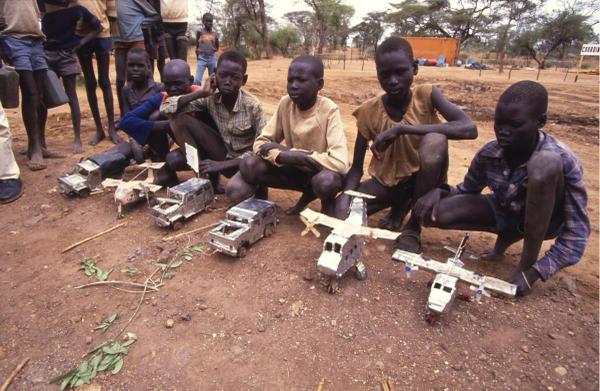
Parked inside a small compound in juba, South Sudan is a small light aircraft. The plane was designed and built created by 23-year-old George John Male. George is a high school student who discovered his talent for airplanes when he was just about five-years-old.

This is his second prototype.  He built the plane using local materials such as scrap metal and discarded plastic and sacks.

“This isn’t my first work or my first event. I have done a lot since I was a kid. I have been doing some research and trying to find out how to make small air crafts and then make them. The one I made before this one was actually a UVA – unman aero vehicle.  But I didn’t have a system to control it, the wiring GPS and all this so I came with an idea for second one that could carry a weight of a person powered by a gasoline engine almost like generator but a little bit different that you can adjust the speed,”

George works at home, where he has turned his room into his workshop — which he calls “aero tech research.”

He uses his artistic, drawing and painting skills to design airplanes.  He develops his prototypes using information he finds on the internet.

George wants to study aeronautic engineering, but his dreams were interrupted by the ongoing fighting in the country – and there is no college or university here where he can study aeronautics.  But despite the challenges, he remains optimistic.

“There were some times whereby I am discouraged because when i do these things, they say that i am crazy and all this. Even some times when i bring the materials, i sneak them into the house through the fence so that they will not see, if they see it they will say that i am wasting money on crazy stuffs.”

Finding funding for his projects is difficult.  He even took his first aircraft design to the country’s air force.

“The first plan i made before this, i took it to the air force, but since then, nothing was done about it was just left and trashed by wind. Actually, they told me they will fix a program to take me for studies but since then i have been here nothing was done about it,”

Although, George’s plane isn’t quite ready for passengers yet, he believes with the right support he can become one of Africa’s greatest aerospace innovators.
Nigerian Hit TV Series “ Dawn in the Creek”

DAWN CreekBy Paul Ndiho

Renowned Nigerian director Jeta Amata, last week joined two U.S State Department officials at the agency’s headquarters in Washington for the viewing of “dawn in the creeks” a new reality TV show that focuses on the Niger delta.
Created by Nigerians for Nigerians – “Dawn in the creeks” is a new hit TV series in Nigeria showcasing stories of non-violent problem-solving and peaceful cooperation between Niger delta communities and local governments.
Nollywood filmmaker, Jeta Amata is the executive producer of the series, and he says the TV show is having a huge impact on the Niger delta residents.


“I tell you that people, who are meant to be fighting right now, or doing bunkering and things like that, are doing different things now, they are talking to their friends and they’re making films instead.”
Jeta says he embarked on a journey to find solutions that could bring peace to a region that has been the epicenter of conflict. The program addresses social, economic and political issues of young Nigerians through their own voices — by teaching them to become the next generation of filmmakers. The youth are taking advantage of this unique opportunity to sharpen their producing, writing, directing and film editing skills.
“They are telling people look we can do things differently. So that is good enough and it’s a seed planted in them. The community is begging to discuss the problems they’re going through; no one is bottling it up. No one is thinking about fighting, they’re thinking how we can solve it. This is the best thing that can happen to them.
With the support of the United States, the producers of the show visited different communities in Rivers, Bayelsa and Delta states to form a seven-person team of local youths with inspiring stories to tell. And that’s the basis for the reality show. Ambassador Rick Barton is the assistant secretary, bureau of conflict and stabilization operations at the U.S State Department.
“I think it’s an innovative way for the United States to practice 21st century diplomacy. It captures people’s imagination, it goes to local ownership, and it shows that Nigerians have solutions to their own problems.”
Expressing optimism about the hit show U.S Consul General, Jeffrey Hawkins, says that it goes a long way toward solving the challenges the country faces in the Niger Delta.
“Niger delta is really important, it’s where the oil is, it’s where so much of the problems have been in the past but it’s also a place where an amnesty process had sort of put a band aid on some problems and allowed some space for creative thinking about how we might change that narrative.”
Nkemakonam Linda, a Nigeria-American originally from Delta State, says that show resonates with her in so many ways.
“I have lived there, I’ve experienced these problems and I was practically shaken and I was crying because it reminded me of a few friends that I have lost because of this conflict and I’m glad someone is finally empowering the youth — to tell their stories.”
Nigeria’s movie industry has greatly evolved since the 1960’s – to become Africa’s largest film industry according to the u-n educational, scientific and cultural organization.
Despite the industry’s growth, government investment in the industry remains slow. Most films are shot on digital cameras, with tight budgets – often compromising sound and picture quality.
Nollywood films are soaring in popularity across Africa, because they often touch on issues many people can relate to.

UGANDA TO HOST AFRICA TRAVEL ASSOCIATION’S (ATA) 39TH CONGRESS IN NOVEMBER

By Paul Ndiho, Washington DC

Tourism in Africa is rising and organizations like the Africa Travel Association (ATA) are working hard to sustain this growth, by spreading the word about places to visit in Africa. More than 600 delegates from over 30 countries are expected to attend this year’s Africa Travel Association’s world congress in the Ugandan capital, Kampala.Tourism Edition

The goal is to promote tourism, share, and experience the unique attractions Uganda offers beyond gorilla tracking, which remains the backbone of the country’s tourism industry. Edward Bergman is the Africa Travel Association’s executive director.

“Uganda of course has incredible tourism potential and has amazing tourism attractions and sights. The people are warm and hospitable, it‘s a destination where there is an increasingly growing demand for tourism, and we want to help to bring increased attention to Uganda’s tourism but also it is a very important country in Africa.

Hon. Maria Mutagamba, Uganda’s Minister of Tourism, Wildlife and Antiquities has pledged her full support to the ATA and has reassured the international community that the anti-homosexuality act signed into law by President Yoweri Museveni in February, was struck down by the Nation’s Constitutional Court in August and is no longer in place.

“I want to assure all the people in America and all over the world that Uganda is a democratic country. The anti-homosexuality act was a private members bill, which came to parliament and because of the excitement at the time, and our parliament passed it. Subsequently, it was signed into law by the president. But logic prevailed and when the Judiciary came in, they analyzed the grounds and it was nullified. As government we respected their decision. And so, the law is no longer in place. I want to assure everybody, to please come to Uganda. Whether you have an inclination to homosexuality or gay people or whatever or gay that is none of our business. Please come and visit our beautiful country.”

Mr. Stephen Asiimwe, the chief executive officer of Uganda Tourism Board, a government agency that is essentially charged with promoting tourism says that Uganda is gifted by nature.

“Tourism, for Uganda particularly is a very broad concept. I will begin with the most visited issue in Uganda, which is wildlife and nature. We are home to the world’s largest concentration of primates. We are looking at chimps, monkeys, baboons, apes and mountain gorillas.

Susan Muhwezi, ATA’s Uganda chapter president, says tourists should come to Uganda because of its beautiful people, its beautiful culture, the dances, the different tribes and the diversity that cannot found anywhere else.

“I am here to invite the American citizens, the tour operators, and the travelers and anyone who’s interested to realize their dream, to see the best-kept secret of Africa.”

Babra Vanhelleputte, chairperson of the Uganda Association of Tour Operators says Uganda has many unique qualities.

“We have a varied culture and very rich, we have over 56 tribes, and each one has their own dress, their own language, their own food. We have a very hospitable people, very beautiful country, all year-round summer-like conditions.”

Kelley MacTavishan, an American citizen and proprietor of Pearl of Africa Tours and travel, has lived and worked in Uganda for the last 23 years. She says that timing of this 39th congress could not have come at a better time.

“So going to Uganda with an open heart and a good mind gets you far because the people are extremely generous, very friendly, and very giving. So the weather and the people and the climate and the clothing are fabulous.”

Tourism analysts say this world class event will serve as a catalyst to promote Uganda’s investment both in international and regional tourism.