Author Archives: Paul Ndiho

U.S.–Africa Deportation Deals Balancing Strategic Diplomacy and International Law

By Ndiho Media
The Trump administration’s agreements with Rwanda, South Sudan, and Eswatini to accept deportees labeled as dangerous criminals have drawn both praise and criticism. Supporters see them as a diplomatic breakthrough that strengthens U.S.–Africa ties, while critics warn they raise serious legal and ethical questions under international law.
Joseph Szlavik, Partner at Scribe Strategies & Advisors and a key figure in behind-the-scenes negotiations with these African governments, says the arrangements are rooted in long-standing policy.
“This isn’t the first time the United States has deported people to a third host country. There are preexisting treaties and policies—like the ‘Safe Third Nation’ agreements we have with Canada and Mexico. President Trump is not setting a new precedent here,” Szlavik told Ndiho Media.
Szlavik explains his program as fixing a logistical issue: some countries of origin will not repatriate citizens, especially at moments of strained diplomatic relations, like with Cuba or Venezuela. He specifies that those being rescreened are “hardened criminals—people convicted of murder, rape, and other serious crimes” and not ordinary migrants.
For Szlavik, they also provide an ample diplomatic opportunity.
“Under President Trump, embassies are quickening their response to U.S. queries. It demonstrates Africa rising as an international partner and taking part in solution-oriented approaches beyond aid,” he said.
However, David O. Monda, who is a journalist as well as a professor at City University of New York – Guttman Community College, does not concur. In his argument, he asserts that arrangements risk violating U.S. constitutional protections, together with the non-refoulement rule at international law, where individuals cannot be transferred to states where they will not enjoy their rights or safety.
“All three countries are small, landlocked, and poor, with unstable political systems and human rights concerns,” Monda said. “It’s an elephant and ant situation—an asymmetrical power dynamic where the U.S. holds all the leverage.”
Monda challenges the morality of dispatching people who have not been to Africa to countries where they do not have connections.
“It creates the perception that Africa is becoming a dumping ground for America’s rejects,” he noted, adding that larger African countries like Kenya and Nigeria have rejected similar proposals.
Though Szlavik points out that the Supreme Court upheld the legality of the program and African governments’ willingness to cooperate, Monda warns against circumventing due process.

Behind the Scenes: How Trump’s Africa Deportation Deals Are Strengthening U.S.–Africa Relations

By Ndiho Media Staff

The Trump administration’s agreements with Rwanda, South Sudan, and Eswatini to accept deportees labeled as dangerous criminals are being praised by those familiar with the process, who say the deals are legal, strategic, and strengthening U.S.–Africa partnerships.

Speaking exclusively to Ndiho Media, Joseph Szlavik, Partner at Scribe Strategies & Advisors, revealed that he has been heavily involved in behind-the-scenes negotiations with these African governments to make the arrangements possible.

“This isn’t the first time the United States has deported people to a third host country. There are preexisting treaties and policies—like the ‘Safe Third Nation’ agreements we have with Canada and Mexico. President Trump is not setting a new precedent here,” Szlavik explained.

The program addresses a logistical problem: some nations refuse to take back their citizens, particularly when relations with the U.S. are strained, as with Cuba and Venezuela. In such cases, African partners have stepped in.

“South Sudan took in eight people, including Cubans with serious criminal records, because returning them to Cuba was impossible,” Szlavik said.

He stressed that those deported under these deals are not ordinary migrants.

“These are hardened criminals—people convicted of murder, rape, and other serious crimes. There’s not a lot of sympathy for them,” he said.

Beyond security, Szlavik views the agreements as part of a broader diplomatic and humanitarian strategy. His direct involvement in discussions has helped persuade African governments to see these arrangements as mutually beneficial.

“Under President Trump, requests to process deportees are taken seriously. Embassies are more responsive, and it shows Africa stepping up as a global partner,” he said.

Szlavik also underlined that diplomacy is often conducted discreetly.

“Foreign policy is not negotiated on live television. These talks were legal, went to the Supreme Court, and the court confirmed they’re fully within the law,” he said.

The deals align with Trump’s “trade, not aid” approach to Africa. Szlavik pointed to the administration’s efforts in advancing peace talks—such as between Rwanda and the DRC—and encouraging political transitions in countries like Guinea and Gabon.

“President Trump has taken a personal interest in Africa. He likes building one-on-one relationships with leaders. When there’s respect and direct dialogue, good things happen,” Szlavik said.

For supporters, these deportation deals are not just about immigration—they’re about reshaping U.S.–Africa relations and treating African nations as equal partners in solving global challenges.

Inside Sudan’s Forgotten War

By Ndiho Media

As Sudan’s civil war rages on, the humanitarian crisis is worsening by the day. In an exclusive conversation with Different Perspectives, Sudanese journalist and activist Shakoor Nyaketo offered a stark update from the ground.

“Life is actually difficult and getting more complicated day after day,” he said. “The war is escalating and reaching many states we didn’t expect. People are suffering.”

Since April 2023, Sudan’s conflict has pitted the Sudanese Armed Forces (SAF) against the Rapid Support Forces (RSF)—two former allies turned bitter enemies. “These are two military factions… once part of one force,” Nyaketo explained, “now fighting each other due to political disagreements.”

The toll on civilians is devastating. “There’s famine. Hunger. People are eating tea leaves. People are dying,” he said. “There’s no food, no medicine, no shelter—everything is scarce, and everything is expensive.”

While some aid is trickling in, it’s far from enough. “WFP trucks crossed the western border a few days ago,” he noted, “but it’s not safe. Most international agencies have either fled or are struggling to access these areas.”

Women and children are bearing the brunt of the crisis. “They are the most vulnerable. They are the ones paying the price for a war they didn’t start and don’t support.”

Nyaketo called on both local and international actors to stop focusing only on aid and start pushing for peace: “If we keep asking the international community just for food, the war will continue. We need pressure on the warring factions to stop fighting.”

If left unresolved, he warned, “we might lose another part of the country—just like we did with South Sudan.”

Uganda’s Refugee Crisis Reaches Breaking Point, UNHCR Warns

By Ndiho Media

Uganda, long praised for its progressive refugee policies, is on the verge of a humanitarian catastrophe as conflicts in Sudan, South Sudan, and the Democratic Republic of Congo force thousands to flee across its borders daily. The UNHCR warns that without urgent international support, lifesaving aid will collapse. The situation has become untenable,” warns Dominique Hyde, UNHCR’s Director of External Relations. “We simply don’t have the resources for basic needs, whether it’s water, shelter, or food. I’m seeing malnourished children and desperate women arriving with almost nothing,” Hyde said in a recent assessment in Kiryandongo settlement.

The country currently hosts nearly 2 million refugees, half of them children. But severe funding shortfalls have slashed food rations by 50% and triggered a 300% spike in malnutrition cases. Overcrowded classrooms, some holding 200 students each, leave many children without education.

The World Food Program says $500 million is needed by September to prevent starvation. Yet every day, 600 new refugees arrive, often with nothing. While Uganda grants them land and work rights, the lack of tools and seeds leaves families destitute.

“Uganda’s generosity is unmatched, but without funding, we cannot help.”

 Hyde acknowledged, referencing the nation’s progressive policies granting refugees land and work rights. “

Children now drop out of school to labor, women trek 10 miles daily for water, and mental health workers report a growing suicide crisis. As global attention wanes, the question remains: Will the world act before it’s too late?

What do you think about Uganda’s refugee policies? Share your perspective with Ndiho Media on Instagram, Facebook, LinkedIn, and YouTube.

UN Report: Global Hunger Falls Slightly, But Africa’s Crisis Deepens

By Ndiho Media

World leaders gathered in Addis Ababa, Ethiopia, at the end of July, for the UN Food Systems Summit Stocktake (UNFSS+4), where a UN report highlighted a concerning trend: while global hunger is decreasing, Africa’s situation is worsening. The State of Food Security and Nutrition in the World 2025 (SOFI 2025) report indicates that 673 million people, or 8.2% of the global population, faced hunger in 2024, an improvement from 8.5% in 2023 and 8.7% in 2022.

Global progress in addressing hunger conceals increasing regional inequalities. Maximo Torero, Chief Economist of the FAO, highlighted that Africa’s hunger situation is worsening, while South America and Asia, particularly India, have seen improvements. In South Asia, hunger rates dropped from 7.9% in 2022 to 6.7% in 2024, and in Latin America, undernourishment decreased from 6.1% in 2020 to 5.1%. Conversely, Africa faces a severe crisis, with 307 million people undernourished—over 20% of its population. If trends persist, nearly 60% of the world’s hungry will be in Africa by 2030. Alvaro Lario, President of IFAD, emphasized the alarming food insecurity in Africa, where 59% of people are affected, significantly exceeding global averages. Rising food prices have critically impacted poor, rural households.

In Chad, the food crisis is severe, with over 3.3 million people facing acute food insecurity due to drought, floods, rising prices, and conflict from Sudan. However, there are signs of resilience. IFAD’s Crisis Response Initiative (CRI) is assisting farmers in Amlibis, near N’Djamena, by providing food aid, drought-resistant seeds, and essential infrastructure like a grain storage warehouse. This initiative has also trained local farmers in post-harvest handling and risk preparedness.

As talks in Addis Ababa focus on reforming global food systems, the SOFI 2025 report highlights Africa’s critical situation. Without coordinated international action, the hunger gap between Africa and the rest of the world will widen. Rural communities like Amlibis need more than temporary aid—they require investment, infrastructure, and long-term support to help families, farmers, and children survive.

Angola Unrest: Calm Returns,But Anger Still Boils Beneath

By Ndiho Media Staff | Luanda, Angola

After days of violent protests sparked by a sharp increase in fuel prices, Angola is slowly regaining its footing—but the scars run deep, and tension remains high.

Mario Palva, an independent journalist based in Luanda, told Different Perspectives that while the official taxi strike has ended, the capital is far from normal.

“The strike is officially over, and buses are back, but things are only slowly returning to normal,” said Palva. “There’s still a strong police presence, especially near key buildings and government offices.”

Over 1,200 people have been arrested, and rushed trials are already underway. The Angolan Bar Association has raised red flags about access to legal representation.

“They’re calling for fair trials and legal access. It’s not happening fast enough,” Palva reported.

At least 30 people have been killed, including a young mother of two, whose death has sparked public outrage.

“Her shooting triggered a wave of anger from civil society and opposition leaders,” Palva added.

The violence spread beyond Luanda, hitting cities like Malanje, Lubango, and Cabinda.

Over 70 shops were looted. Buses and private cars were torched. Even rural areas weren’t spared,” said Palva.

While government officials blame opposition groups for the unrest, Palva says the frustration runs much deeper.

“This isn’t just politics—it’s poverty, unemployment, and a growing sense of hopelessness among the youth.”

With rail workers still on strike and more protests brewing in oil-rich provinces, many fear the unrest is far from over.

“Unless the government opens dialogue with unions, opposition parties, and civil society, this anger will resurface,” Palva warned.

“Monday was chaos. Roads were blocked. No one feels safe, especially after dark.”

Ivory Coast’s Ouattara to Run for Fourth Term

By Ndiho Media/ABIDJAN, Côte d’Ivoire

Ivory Coast’s political landscape has been thrown into fresh turmoil following President Alassane Ouattara’s announcement that he will run for a controversial fourth term in October’s presidential election. At 83, Ouattara says the move is aimed at preserving national stability — but critics argue it’s a dangerous consolidation of power that risks plunging the country into renewed chaos.

“For him to run again, we were not surprised. There were signs,” said Dr. Gnaka Lagoke, Associate Professor of History, Philosophy, and Religion at Lincoln University, in an exclusive interview with Different Perspectives. “Yes, the 2016 constitution made some amendments — but it’s a political smokescreen. It’s not legally justified.”

Ouattara’s 2020 re-election already stirred controversy, as he reversed his earlier pledge to step down. Now, with key opposition figures — including former President Laurent Gbagbo, Guillaume Soro, and Tidjane Thiam — barred from running, the field is effectively being cleared for a one-person race.

“How do you justify excluding all your major opponents?” Lagoke asked. “They’re using the institutions of the state to sideline any real competition. This isn’t democracy — it’s political engineering.”

Lagoke warns that such tactics could stir unrest reminiscent of the 2010–2011 post-election violence that killed over 3,000 people. “Ivory Coast never had true reconciliation after that conflict. Many voices were silenced, some were imprisoned, others died in exile.”

When asked about the credibility of this year’s election, he didn’t hold back: “It’s like playing football on a tilted field where one team has their hands tied behind their backs and the referee works for the other side. That’s not a fair game.”

While the Ouattara government touts economic growth and infrastructure development, Lagoke calls it a mirage of prosperity. “Yes, there are nice roads and bridges. But who owns them? Multinational companies. Meanwhile, the people still import rice and basic goods. That’s not sovereignty. That’s dependency dressed up as development.”

Lagoke says many Ivorians feel powerless. “At least 50% of the population is against this move, but with major opposition candidates disqualified and protests banned, what democratic options are left? Even people within his own party are uneasy.”

Civil society and religious groups have raised concerns over growing political polarization. Yet institutions like ECOWAS, the African Union, and the United Nations have remained largely silent.

“These bodies rush to condemn military coups but go mute when democracy is dismantled through legal trickery,” Lagoke said. “What’s happening in Ivory Coast is a constitutional coup, and it’s not unique. We’ve seen similar attempts in Senegal, Guinea-Bissau, and elsewhere.”

He added, “Ivory Coast is just one example of a broader crisis of leadership across Africa. Many Africans want change, accountability, and Pan-Africanism — not leaders who serve foreign interests while silencing their own people.”

As the October vote looms, the stakes are high. “Ouattara may believe he’s securing stability,” Lagoke concluded, “but silencing dissent, jailing opponents, and suppressing protests — that’s not peace. That’s fear. And fear doesn’t last.”

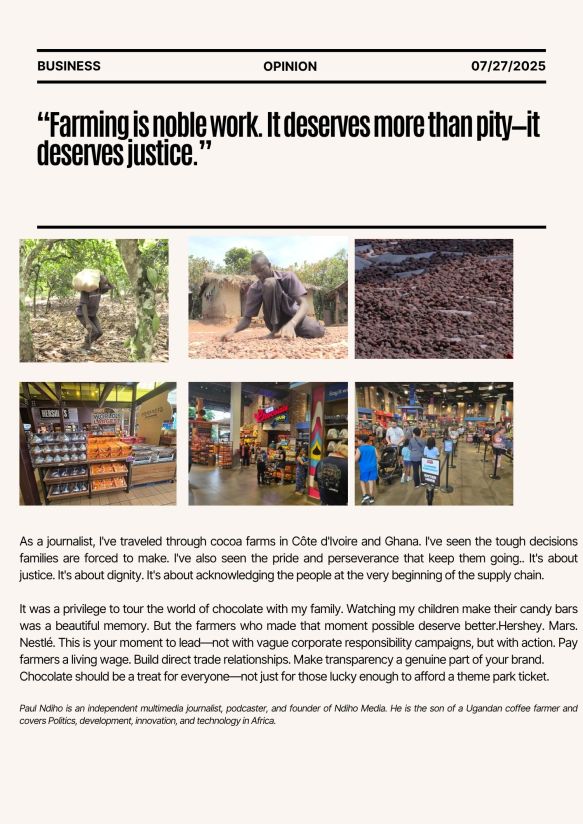
From Cocoa Fields to Hersheypark: A Farmer’s Son Sees Both Worlds

A Journalist with a Point of View

Rugby Fever Grips Kampala as Africa’s Best Clash for World Cup Spot

BY NDIHO MEDIA – KAMPALA, UGANDA

The 2025 Rugby Africa Cup has brought Kampala to life with high-octane rugby action, as eight of the continent’s finest clash for glory—and a coveted spot in the 2027 Men’s Rugby World Cup. The tournament features Zimbabwe, Algeria, Namibia, Kenya, Senegal, Côte d’Ivoire, Uganda, and Morocco, all battling it out in front of roaring fans at Mandela National Stadium and Wankulukuku Stadium.

“This year’s tournament has been absolutely electric,” said David Monda, a Pan-African writer and rugby enthusiast covering the event on the ground. “Matchday two was stacked—Uganda played Morocco, Zimbabwe clashed with Kenya, Namibia took on Algeria, and Côte d’Ivoire faced off with Senegal. The competition has been fierce.”

Uganda, the host nation, has faced an uphill battle. “The loss to Morocco shocked everyone,” Monda admitted. Morocco entered as the lowest-ranked team, having been newly promoted from the second tier. For them to beat Uganda on home soil? That’s a wake-up call.”

He pointed out a clear divide forming in the tournament: “You can see the top four—Namibia, Zimbabwe, Kenya, and Algeria—are operating at a higher technical level. But Senegal, Côte d’Ivoire, Uganda, and Morocco are fighting hard and showing moments of brilliance.”

Monda also highlighted how the Cup is impacting Uganda’s international profile. “Hosting back-to-back tournaments is huge,” he said. “It puts Uganda on the map for sports tourism and diplomacy. But it also brings scrutiny—especially when the home team underperforms.”

Looking ahead to the final on Saturday, July 19, Monday believes Namibia remains the favorite. “They’ve got the experience and a psychological edge. But don’t count out Zimbabwe—they’re hungry, and they’ve already beaten the UAE in a friendly. If they don’t win the final, they still have a shot through the repechage.”

Beyond the scorelines, Monda emphasized the need for deeper investment in African rugby. “We need better funding, stronger player welfare, and more regional competitions,” he said. “If Africa’s going to compete globally, we have to build from the grassroots up.”

As finals weekend approaches, Uganda finds itself in a fight for both pride and survival. A loss to Côte d’Ivoire could see the Cranes relegated to tier two.

Nigerian Ex-President Muhammadu Buhari Laid to Rest in His Hometown of Daura

By Ndiho Media – Abuja, Nigeria

Nigeria has bid farewell to one of its most consequential and controversial leaders. Former President Muhammadu Buhari was buried Tuesday at his private residence in Daura, Katsina State, two days after he died at age 82 in a London clinic.

His body was flown back to Nigeria aboard a presidential aircraft and received by President Bola Tinubu at the Umaru Musa Yar’Adua Airport in Katsina. From there, a somber procession carried the late leader’s remains to Daura, where hundreds gathered for Islamic funeral prayers at the town’s central mosque.

Buhari was then laid to rest in the grounds of his home, in a simple ceremony attended by dignitaries including President Tinubu, Guinea-Bissau’s President Umaro Sissoco Embaló, former Vice-President Yemi Osinbajo, and members of the late leader’s family and inner circle.

The ceremony capped off a day of national reflection, as Nigeria observed a public holiday and entered the second day of a seven-day mourning period declared in honor of Buhari.

But the burial also marked a moment of reckoning.

“He meant well for Nigeria—but the system around him failed him,” said Sir Leonard Anyogo, a constitutional lawyer and political analyst based in Abuja, in an exclusive interview with Ndiho Media. “He was a disciplined man, a patriot, but his cabinet was riddled with scandals he didn’t address. That’s part of his legacy too.”

Buhari, who initially ruled as a military leader in the 1980s and later returned to power to win democratic elections in 2015 and 2019, was seen by many as a symbol of integrity and honesty. Others viewed his presidency as a missed opportunity.

“Even in death, Buhari’s journey raises questions,” Anyogo added. “He died in a foreign clinic—despite leading a resource-rich nation with brilliant medical professionals. Why couldn’t we build a hospital in Nigeria good enough for our own presidents?”

While his tenure was marked by bold infrastructure projects, such as the Second Niger Bridge and new rail lines, it was also marred by rising insecurity, economic hardship, and persistent institutional weaknesses.

“Leadership in Nigeria isn’t just about good intentions,” Anyogo noted. “It’s about building systems that work—even after you’re gone.”

« Older Entries Recent Entries »