Category Archives: P

Africa’s growing middle class

By Paul Ndiho

One of Kenya’s biggest stores – Uchumi, is planning to spread its footprint across east Africa.  The retail giant is bouncing back several years after it was declared bankrupt.  Uchumi hopes to open at least eight new branches by 2014, as it expands into Rwanda and South Sudan to tap into the growing middle-class market.

Africa's Middle Class

The African development bank says Africa has the one of the fastest growing middle class populations in the world.  Some financial experts attribute the growth to increased investments in the service sector– and sound economic and business policies.  As a result, both foreign and local investors are considering investing in Africa, especially in retail stores. Kenya’s Uchumi supermarkets is one of a kind, it is the only stocks-listed supermarket group in east Africa.

Jonathan Ciano, Uchumi’s chief executive officer says the company is preparing to tap into the growing middle class, and take the supermarket concept to communities that have never had one.

“We have cast our eyes even further, saying we want to have at least five more branches in Tanzania, additional branches in Tanzania, three more in Uganda and approximately six or seven in Kenya in the next two years. Minimum and that is what it is, we are counting on those that we have precipitated their growth, or they are building up or be determined.

Economic forecasters say investors expect Uchumi to perform better in the medium term, after making significant investments in branch expansion in the region over the past two years.

The company emerged from a four-year receivership in early 2010 and its shares were re-admitted for trading on the stock exchange in mid-2011.

The firm is still working on how it will get into Rwanda and south Sudan, but the first six stores to be opened elsewhere this year have been approved by the board of directors.  The C.E.O. says that the opportunities for retailers are not confined to big cities like Kampala, the Ugandan capital.

“Most of us are spoiled because we have been brought up in the cities – Kampala, Dar es Salaam, but we have our brothers and sisters who are 300 kilometers in the hinterland, who have never seen a supermarket and you open one there and you can see the excitement as they all get employed and embodied into it, quite interesting,”

Critics say that Uchumi’s sluggish sales in the last two months of 2012 sent pretax profits plunging by 35 percent– to $1.56 million dollars, for its fiscal first-half year that ended December.

However, Ciano dismisses those claims and says that the sales have been going on well, adding he expected that trend to continue and that the growth of the company showcases the numerous opportunities available in Africa.

“Africa was called the dark continent. They didn’t know the sun was right in the middle of Africa. It is a very bright continent, when you come to the infrastructure; it’s an ongoing development that is why we are developing countries.”

Some analysts say that both foreign and local investors have nearly tripled their shares in Uchumi since last year and the demand for quality products in supermarkets will continue to climb because more and more people are rising into the middle class.

MTN TELECOMMUNICATIONS TO EXPAND IN AFRICA

By Paul Ndiho

One of Africa’s largest mobile phone companies is working on expansion plans that could see the firm spend billions of U.S. Dollars on the continent. MTN telecommunications group, which has a market value of over 30 billion dollars, is eyeing Africa’s data market– a market that has yet to be fully tapped.
MTN mobile Phones

Incorporated in 1994, MTN is arguably Africa’s biggest mobile phone company, operating in 21 countries. It also provides internet service to businesses in 13 countries, spanning three continents.  The Tele-communications giant is set to spend up to 8 billion dollars in acquisitions and investments on the continent.

MTN is also one of 15 telecom providers to make the cut to a second-round of bidding for an operating license in Burma, also known as Myanmar, according Sifiso Dabengwa, its chief executive.

“We still are looking at growth in terms of mergers and acquisitions opportunities; there are areas which we are keen on getting licenses. We are participating in the Myanmar licensing processes where they will license two operators, between now and June this year. There are some countries in Africa on the north coast that we would still be interested in going into and also other countries stand alone, which we believe have good opportunities which we can create value from.”

The south african-based mobile operator which has a market value of $34 billion is interested in acquiring a North African provider, to help diversify its earnings.  MTN expects to repatriate nearly 135 million of its funds tied up in Iran this year– and the company has been talking with the Iranian central bank and U.S. Authorities on returning its dividends without violating sanctions.

A U.S. Court has delayed a $4.2 billion lawsuit against it by Turkish rival Turkcell, pending a separate Supreme Court decision.  Turkcell alleges that MTN used corrupt practices to win an Iranian operating license.

However, an external committee appointed by MTN has, found the allegations to be false and that the company’s lawyers are confident that the Washington, dc court will throw out the case because it did not fall under its jurisdiction.

Still– the top executive says the data market in Africa is not being maximized and there is room for growth.

“Most of our markets are still under 10 percent, the key issue is that the penetration of devices that would drive data is still low, i think affordability of the devices is still a problem and as devices become more affordable, as prices come down, we will have more 3g handsets, more limited functionality smart phones, and that will definitely drive data. Internet penetration is still below 10 percent in most countries, so the opportunity is still very big.”

In 2010, MTN invested in fiber-optic cables, as well as growing its access to broadband capacity on undersea cables.  Analysts say that MTN predominantly uses independently owned outlets to distribute its products and services, but it also has its own branded stores.   The Tele-communications giant employs more than 34-thousand employees.

MTN recently received a license in Ethiopia to provide essentially all services other than standard voice calls.  The east African nation has a very limited Tele-communications industry.

SIERRA LEONE TROOPS IN SOMALIA

By Paul Ndiho

Last months, the African Union Mission in Somalia (AMISOM) welcomed its new member from the republic of Sierra Leone, Sierra Leone’s Armed Forces (RSLAF). The advanced team joined Uganda, Kenya, Burundi and Djibouti in the fight against al Shabaab. The 850-strong contingent will be deploying shortly into southern Somalia where they will operate alongside the Kenyan contingent. Paul's Interview with President Koroma

Sierra Leone became the fifth African Country to join Amisom forces in Somalia, in the fight against al Shabaab a hardline Islamist group with links to al Qaida which has risen from obscurity to international prominence in the last couple years.

Critics of the Sierra Leonean government say the soldiers are needed back home to prevent possible violence, since they contend that their country is still recovering from the civil war that ended in 2002. Last month, while speaking to VOA, President Ernest Bai Koroma dismissed those critics and said that it was his country’s time to payback time to the international community.

“Now if we have gotten to a point wherein we have transformed our country from a warring country to a country that is moving on in development and growth, there is a need for us to support other countries who are now in the position that we were in some years back.”

The Sierra Leonean deployment will permit the Kenyan troops in Southern Somalia, to withdraw one battalion from the sector as per UN Security Council Resolution 2036 that was passed in 2012.

“We will be joining in the rest of the other contingents in AMISOM to ensure that we will be able to implement the African Union mandate in Somalia. The peace process is currently on enforcement; however the news is telling people that Somalia is getting back to where it was, so our main focus now is to assist in the stabilization of Somalia.” Said Lt. Colonel Abubakar Conteh, Sierra Leone Contingent, AMISOM:

Sierra Leone was engulfed in a civil war for more than a decade that left more than 50,000.00 people dead and hundreds of thousands displaced. It was regional forces under the umbrella of The Economic Community of West African States Monitoring Group or ECOMOG that intervened and restored calm. Now Sierra Leone’s Armed Forces feel that it’s their turn to partake in such missions.

“We are now partakers of global peace enhancement, and of course during our own ten years of civil war, people came from different countries to support our peace achievement, and now that we have the opportunity to reciprocate that particular aspect, we are very happy:”

A resident of Free Town share the same sentiments.

“I’m happy because this shows that our country is improving, we are now members of the international community, our soldiers are being called up for peacekeeping missions, it makes me really happy,”

The AU Peace and Security Council authorized the integration of a contingent of RSLAF into AMISOM early last year. Since then, AMISOM troops, in support of the Federal Government of Somalia, have pushed Al-Qaeda affiliated al Shabaab terrorists from much of south-central Somalia.

Perspectives: The International Criminal Court and It’s Focus on Africa

By Paul Ndiho, Washington, D.C

April 9, 2013

Over a decade ago, representatives from more than 100 member states gathered in Rome to establish the international criminal court.  The court investigates and tries cases of war crimes and crimes against humanity. The International Criminal Court has recently come under scrutiny because it appears to be primarily focused only on African conflicts.Analysis on ICC

All eyes are on Fatou Bensouda, a Gambian national who was elected in December 2011 to serve as the first African prosecutor for the I.C.C.  Initially, Bensouda was overwhelmingly supported by African countries, but now critics say the court is biased because the majority of its investigations and indictments are seemingly centered on Africa and its leaders.  But the chief prosecutor is not taking the charges lightly.

Africans are beginning to pay more attention to the ICC’s interest in their continent, according to David Bosco, an assistant professor at American university’s school of international service in Washington, dc.  Bosco authored the book International Criminal Court, “Rough Justice” and he recently penned an article in the Washington post questioning “why the ICC is picking only on Africa”.

“Well it is very striking that were now more than a decade into the ICC’s operations and every investigation and every person indicted has been African.  And that doesn’t mean that these conflicts that the ICC has investigated shouldn’t be investigated.  But i think many African officials and leaders are wondering why this court, which is international has only focused on Africa, to this point.

The election of Uhuru Kenyatta as Kenya’s president and William Ruto as vice president in March, is yet another test for the international criminal court.  Many Kenyans are questioning the validity of Uhuru’s case at The Hague.  And his lawyers want the charges of crimes against humanity against him dropped, after the ICC case against former Kenyan ambassador Francis Muthaura collapsed, after a key witness was discredited.

But prosecutors say President Kenyatta has to answer for allegedly orchestrating violence after the 2007 election, when some 1200 people were killed.  Like many critics, Bosco notes that the court’s decision to put President Kenyatta on trial is likely to have far-reaching consequences in Kenya.

“It’s going to be very interesting to watch now with Kenya where an indicted individual, two individuals, the president and the vice president have been indicted and they have now been elected.  There’s a question with what’s going to happen with their trials, whether they are going to participate in their trials.  But it seems very possible that the Kenya situation is going to accentuate that already existing tension in-between the court and African governments.”

Some analysts say President Kenyatta’s case is an important test for the heavily criticized Hague court, because he could become the first head of state to be actively defending charges at the ICC.

Despite all the condemnation, the ICC has managed to secure one conviction.  Last July, the court jailed Congolese warlord Thomas Lubanga Dyilo for 14 years for recruiting child soldiers under the age of 15 and forcing them to fight in a war in the democratic republic of Congo in 2002 and 2003.

Dyilo’s co-accused Bosco Natanga also known as “the terminator,” evaded arrest on war crimes charges for more than seven years before unexpectedly giving himself up to diplomats at the U.S. Embassy in Rwanda last month.  Ntaganda is accused of murder, rape and other crimes over a 15-year-period of fighting in Rwandan-backed rebellions in eastern DRC.

“It seems that what happened is the m23 fractured from within, one faction of the group wanted to turn him over, he didn’t feel comfortable obviously seeking refuge with the Rwandan government. And so he seems to have thought that the ICC was his best option.  But it’s an important case; it will be a difficult trial i think.  It will be a long trial, often evidence in these cases is difficult and they’ll be a lot of disputes about what evidences is used.”

Ntaganda’s appearance in court is a much-needed success story for the ICC.  With many of the court’s suspects, including Ugandan warlord Joseph Kony and Sudanese president Omar Al-Bashir, still-at large– and beyond its reach, Ntaganda’s arrival is especially welcome to prosecutors and activists.

http://ironline.american.edu/faculty/david-bosco/

A Conversation with U.S Congresswoman Karen Bass on her recent trip to Africa

By Paul Ndiho

The U.S. Congress is keeping a close eye on the situation in Mali. Representative Karen Bass, (D-CA) Member of the House Foreign Affairs Sub Committee on Africa, was part of a U.S delegation that recently traveled to Mali and other Africa countries.

C0004VOA’s Paul Ndiho recently talked with Representative Bass about the challenges faced by the interim government in Mali and potential solutions.

The latest peace agreement signed in Ethiopia offers the democratic republic of Congo a fresh and much needed glimmer of hope, but the country still faces many challenges. C0001 (1)-1

U.S Representative Karen Bass was asked about the situation in the Democratic Republic of Congo and her hopes for Congolese citizens, suffering from two decades of violence.

The Impact of Social Media In a Work Place

By Paul Ndiho, Washington D.C.

A clinic in London is treating more than 100 patients a year, who are receiving counseling. A study last year by the University of Chicago suggested social media addiction can be dangerous.

imgres

Earlier this year, a study found that social media is more addicting than alcohol and cigarettes.  Millions of people around the world are getting addicted social networking websites such as Facebook, twitter, and Instargram. Users can join networks organized by city, workplace, school and region to connect and interact with other people. Users can also add friends and send them messages, and update their personal profiles to notify friends about themselves.

Despite the obsession, some researchers are suggesting that these social networking sites are very addictive. Gemini Adams is a self-confessed addict. She says its drugs, not alcohol, but Facebook and she uses Yoga is part of digital detox. She won’t use Facebook now for more than half an hour at a time – and once a week she’ll go 24 hours straight without internet altogether.

“I’d signed up to every aspect of Facebook and was utilizing every sort of part of it. Checking in wherever I went and I remember just feeling really kind of revolting and just, you know, gnarled up inside physically because I hadn’t been exercising. And I was just in this position, hunched over a computer and you know my eyesight was worse.”

Despite these concerns, more and more people are flocking to facebook to catch up with old friends make new ones, build up their social networking skills and even shopping.

Social media is now a recognized addiction.  According to a study published last year by the University of Chicago found it can even be more addictive than cigarettes and alcohol. Research shows likes and re-tweets give users a burst of the addictive neurotransmitter dopamine. But a lack of endorsements can provoke jealousy and anxiety. So how much is too much?

“Psychiatrists say the alarm bells start to ring if you’re looking at Facebook, Twitter and all the other Social Media Networks more than 10 times a day. And if that amounts to more than 5 hours, then you might have a problem or see a doctor.”

You’d be surprised to know what people use the social networks for and how much time they spend on it.

Critics say no one is more addicted to social media right now than the media. But some media executives could not disagree more.

Consultant psychiatrist Dr. Richard Graham treats around 100 social media addicts a year at this clinic in London. His patients range from young to old people.

“They start to miss or avoid doing the necessary things in life, even at a fundamental level of self-care. They delay eating or avoid eating or drinking, delay sleep, miss meetings or delay getting into work or college. There are certainly some young people easily passing 9, 10 hours a day using social media.”

In today’s increasingly connected world, switching off may be a lot harder than it sounds. A study commissioned by ESET, almost half of internet users worldwide connect to the web using portable devices as the primary connection device: laptops, ipads, smart phones, and tablets. And that this is indicative of the demand for Wi-Fi hotspots and the need to stay connected at all times.

Technology experts warn that staying connected might be convenient, but users should guard against criminals prowling networks or some people using social media to saying the wrong things. And for addicts — treatment begins with complete abstinence. And for avid users, the sky is the limit.

BlackBerry is Back

By Paul Ndiho

Research in Motion (RIM) dropped its name in favor of the BlackBerry as it unveiled its first two phones with the new BlackBerry 10 system.  The long awaited BlackBerry Q10 will have a physical keyboard, while the Z10 has only a touch-screen keyboard. In full disclosure, I’m an avid fan of Blackberry customer takes a closer look. images

Amid sagging sales in Europe, Asia, North America, and in the developing markets, Blackberry is back – And its generating a buzz in the smart phone market.  Research in Motion (RIM) re -designed the system to embrace the multimedia, apps and touch-screen experience prevalent today.

Unveiling its long-delayed new devices, Thorsten Heins, BlackBerry CEO, said the new phones will give the existing – brands a run for their money.

“Today is actually not the finish line. It’s the starting line.”

The new Blackberry phones will not hit the U.S market until mid-March. Investors did not like that, and sent the stock down more than 8 percent at one point. But CEO Heins was quick to defend the setback.

“It’s not a delay. We always said we would be launching in the first quarter of 2013. So I think we are keeping our word. The reason is that the European process, their testing process is, let me say, quite shorter than with U.S. carriers.”

Analysts say the delay could hurt the already struggling smart phone maker and question  whether there’s time for the once-pioneering BlackBerry to catch up to Apple’s trend-setting iPhone and devices running Google’s Android system.

“The market they are competing against is not static. So a phone today that has a beautiful high-res display, well, right now there are one or two phones that have even higher resolution displays but in 3 months’ time who knows.”

RIM is promising a speedier device, a superb typing experience and the ability to keep work and personal identities separate on the same phone.

Some fans of the phones could not hide their love for the blackberry.


“From a technology perspective, I think what’s very cool about this- this is a restart. This is a re-launch of BlackBerry.”

Financial analysts are starting to see some slight room for a comeback. With smartphone sales growing, the BlackBerry 10 can succeed without iPhone and Android users switching.

However, some critics say regardless of BlackBerry 10’s advances, the new system will face a key shortcoming: It won’t have as many apps written by outside companies and individuals as the iPhone and Android.

“They are at the mercy for the time being of how these two devices do in a hyper competitive market. The idea is to draw out the unique attributes of the platform, the use case, etc. We’ve seen another platform, Microsoft’s; come out with what I think is a truly innovative and unique user experience that hasn’t really moved the needle for that particular platform in the competitive marketplace.”

Overseas, the brand power of BlackBerry has also been plummeting. Once it was seen as a status symbol for the elite. In recent times, iPhone and Galaxy have taken over that privileged spot. But its comeback means they are ready to compete and increase it 3.4 percent share of the global market.

Last year Blackberry expanded its presence in Nigeria, and announced the first official BlackBerry branded retail store in Lagos. The move made the expansion of RIM’s footprint in Africa from its headquarters in Johannesburg, South Africa, and underlines the company’s commitment to its partners and customers in one of the world’s fastest growing mobile markets. Where half of Nigeria’s 4 million smartphone owners use BlackBerrys, and use among the wealthiest segment of society is forecast to increase six fold by 2016.

Africa’s Silicon Valley

By: Paul Ndiho

Growing internet and mobile phone penetration has inspired the Kenyan government to build an IT focused city called Konza. The government’s initiative is expected to take 20 years to complete but it is already being touted as Africa’s silicon savannah.url


An innovations revolution is unfolding in Africa and the East African Nation of Kenya is taking the lead.  Young people are creating new technologies and applications that are driving the country’s economic growth and turning Kenya into a high tech hub that is being promoted as Africa’s answer to America’s Silicon Valley.

Located 70 KM from the capital Nairobi, the project dubbed Africa’s Silicon Savannah will be constructed on a 5,000-hectare of land at a cost of 14.5 billion US dollars.  The I -T city is expected to be complete in the next 20 years and will create more than 20,000 IT jobs by 2015 and more than 200,000 jobs by 2030.

“If we start with Africa we are already at the top three probably after South Africa and Egypt who got into this ICT business a while before us. So we compete very well and we are increasingly competing for position number one because of the innovations, the city that we are putting in place, the government policies and investments to make an enabling environment in order for ICT business to thrive.”

Africa’s silicon savannah is part of an ambitious government plan to develop infrastructure in east Africa’s biggest economy by 2030. Africa is the world’s fastest-growing mobile phone market and was estimated will be home to 738 million handsets, or nearly three mobiles for every four of its people, by the end of 2012, according to an industry survey done in 2011. Kenya’s telecoms industry was among the fastest growing with 29.7 million out of 40 million people having mobile phones.

“Technology will largely impact Africa with mobile penetration and because of the various ways that we have skipped ahead of out predecessors in the west and so mainly because of the mobile phone and the penetration that has happened in Africa.”

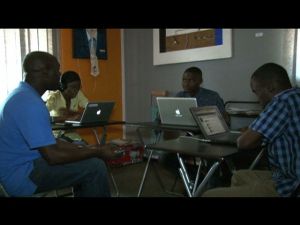
Innovation centers in Kenya like iHub and mLab are helping to incubate and train developers to launch their start-ups and access markets and funds so that come 2030, Konza will be a truly Kenyan affair.

Mobile app developers come to mLab to test their young innovations, on a technical and business front. The mLab has close to 100 different types of mobile handsets used for trials.

“We don’t want a situation whereby Konza city is there there’s all that real estate and there’s all that infrastructure there but the people… the tenants of that city or the residents are being international companies.”

The developers say the city will provide, universities, science parks and establish modern living facilities that cab attract high caliber professionals to the modern lifestyle that will be created there.

The government is expected to finance 5 percent of the total cost then lease land to private investors who can build and run industries in different identified areas.

Nigerian Students Cash in on Google’s Form+ Application

By Paul Ndiho

Three undergraduates of the University of Lagos won the 2012 edition of Google Apps Developer Challenge in sub-Saharan Africa. The students won for creating the Form+ application software which lets anyone create an online resume.Form + Winners

Three students Bolutife Ogunsola, Michael Adeyeri and Willie Aniebiet, from the University of Lagos recently scooped up the 2012 Google Apps Developer Challenge award for developing Form+ application software.

The competition gives a platform to young IT talents in Africa and all around the world to present their innovations.

Form+ is aimed at developing content and ease the process of creating Curriculum Vitae (CV) or resume, submission forms for businesses, as well as facilitating E-Learning, which is not well developed in Nigeria. The developers say, their App, Form+ was born out of a need to provide E-learning solution.

“This is “Form+”, you can access the App via “Form +”. When you get to the site, you have two options of using the app, you can either log in with your Google account or install directly from your chrome web store. So if I choose to log in with my Google account, it brings me to this page where all I have to do is enter my username and password.”

20 year-old Bolutife Ogunsola, part of the trio that created Form +, adds that now that E-Learning is available, there should be more emphasis on pushing for similar solutions.

“They want to do some training for the lecturers to enable them make use of the platform so they can post their lectures online and those kind of stuff, but the problem still remains adoption, will people use the things that already exist? How much drive for adoption exists?”

Google’s program manager and market outreach team for Sub-Saharan Africa, says he is surprised at the response Form+ App has generated so far since its creation.

“The “Form+”, the last time I looked at the application on the Chrome web store, they had more than 12,000 users which for an application that was just launched late last year, you know by a group of students, I think they are doing pretty good. I don’t know how many applications that are launched in this part of the world that gets that many users within the first two, three months of the launch.

Analysts say that developing the Information, communications and Technology (ICT) sector would become a live wire of today’s businesses and an opportunity for youngsters to develop software’s that will be relevant to the local society.

Omotayo Fakinlede, Dean of Engineering faculty at the University of Lagos says ICT development will also to the growth of the education sector.

“Once our environment improves and we can teach better, of course the students are challenged to think better because our teaching is not spoon-feeding the students, education has changed in the modern era. A lecturer is basically now a coach because the information is available on the internet:

Along with the award, the three young innovators also took home 20,000 US dollars, as well as an extra 18,000 US dollars for their department at the University of Lagos

2013 North American International Auto Show in Detroit

By Paul Ndiho

In Detroit, Michigan the home of American automobile industry, Car makers are appealing to egos and a buyer’s desire for status to push a new wave of luxury cars at the North American International Auto show ended this week and will run through January 27th.Auto%20show

Excitement and optimism are dominating the North American International Auto Show. Car lovers say there is a serious luxury vibe this year, as carmakers strive to draw more affluent consumers into showrooms.

The Continental GT Speed Convertible, which makes its debut at the Detroit auto show, is no exception. This car has it all – says Bentley CEO, Dr. Wolfgang Schreiber — there’s only one way to describe it.

“Dream on wheels. It’s a dream on wheels.”

Luxury carmakers in North America held their footing despite a slow recovery from the economic downturn and were able to reinvest in those brands. At the end of 2012, automakers like BMW, Mercedes-Benz and Porsche all reported strong finishes.

At the BMW stand all eyes are on the new 4 series Coupe. Lead designer Adrian van Hooydonk says he designs specifically with the American consumer in mind.

“I saw with my own eyes that people actually use cars differently here. Of course a car is something you absolutely need in and between most American cities. People drive further than in Europe and people see cars as their most important personal accessory.”

U.S. automakers are upping their luxury game too. This new Corvette Stingray has everyone here buzzing. The Stingray is the latest version of America’s most iconic sports car the 2014 Chevy Corvette. The show-stopper is only the 7th model ever designed and is the first and most highly anticipated reveal at this year’s North American International Auto Show.

Tadge Juechter, Corvette’s Chief Engineer says the car is sexy looking, but it feels even better.

“The big story is the way it feels behind the wheel. The way it wraps around you and hugs your body, makes you part of it, so you feel totally in control. It’s super super responsive, it’s a very different kind of driving experience than what people have had before.”

Many analysts predict 2013 sales could slightly back off last years five-year high due to the fog of uncertainty still emanating from Washington.

But nowhere is the recovery of the industry more evident than in Motor City itself. The big three U.S. automakers all reported increases in sales in December. And between them – are rolling out at least 12 new models between them.

TrueCar.com’s Larry Dominique says after bankruptcys and bailouts, the glamour are back in Detroit.

“This Year is different than other years. Going back 3-4 years the auto show was depressing. What we’ve seen over the last 3-4 years is step by step resurgence of energy and excitement. What I’m seeing this year is a tremendous number of debuts from European, Asian manufacturers and domestics. Also seeing a wide range, everything from luxury to entry level vehicles. So what you’re seeing is a tremendous number of reveals, world debuts and overall a lot of energy and excitement.”

In 2012, U.S. auto sales topped out at nearly 14.5 million new vehicles, the best performance since 2007.

Many analysts predict 2013 sales could slightly back off last year’s five-year high due to the fog of uncertainty still emanating from Washington.

But nowhere is the recovery of the industry more evident than in Motor City itself. The big three U.S. automakers all reported increases in sales in December. And between them – are rolling out at least 12 new models between them.

German luxury carmaker Mercedes-Benz expects to sell a record number of vehicles this year in the United States. Daimler CEO Dr. Dieter Zetsche.

“Last year for the first time we sold more cars in the U.S. than in any other market and therefore for us the U.S. market is the number one market and we are putting a lot of focus and emphasis with our great new product being launched in this market.”

Analysts are looking for a sneak preview of the redesigned 2014 Acura MDX, which will appear as a thinly disguised “concept.”

GM’s first luxury hybrid, the 2014 Cadillac ELR, will make its public debut at the show, about a year ahead of the projected on-sale date. The two-door ELR is an upmarket companion to the Chevrolet Volt and is likely to be priced above $60,000.

Among the more mainstream vehicles coming to the show are the Nissan Resonance, a preview of the redesigned 2014 Murano crossover; the Honda Urban SUV concept, which teases the redesigned 2014 Fit subcompact, and the Fiat 500L, a compact five-passenger people-mover that will be marketed as a companion to the tiny Fiat 500 hatchback.

« Older Entries Recent Entries »