Christmas is on Tuesday and people worldwide are looking for last minute gifts for their loved ones. Among the hot items are gadgets like the cell phone and the tablet, which are increasingly in use around the world.
Here to tell us a little more about some of these gadgets is Paul Ndiho, who is an avid mac user, and keen follower of rising technology.
West Africa accounts for nearly three quarters of the world’s cocoa production. Millions of people are employed by the sector or indirectly rely on cocoa farming to make a living. Analysts are projecting that this season cocoa production is likely to surpass more than 2.8 million tons during a year-long period that began in October 2012.
The West African nations of Ivory Coast and Ghana are the two leading Cocoa producers in the world followed by other producers including, Nigeria, and Cameroon. The majority of cocoa produced in the region is grown by small-scale farmers who are located in remote areas.
Cocoa farmer Eugene Koffi Anzoua works in his field in the Brofodoume region in Ivory Coast, picking cocoa pods, drying and cleaning the beans — all in the name of quality.
“A week after drying, we proceed to marketing our produce to buyers. If there is a co-operative, we deliver the goods to this which carries it to the port,”
Cocoa is a delicate and sensitive crop and farmers must protect trees from the wind and sun. They must also fertilize the soil and watch for signs of distress including attack from pests and disease. Some farmers have limited access to credit and have difficulty in obtaining farming supplies. Paul Mensal, secretary of a local Cocoa Farmers Association in Ghana observes that the government has not done enough to help the farmers.
“The yields for this year have gone down due to lack of spraying materials. The amount this year has decreased totally. We are suffering; pests are spoiling our Cocoa. I suggest that the government must supply us with more chemicals. The price that the government is giving us is very, very low. Its two dollars to the kilo and we the farmers suggest that they must buy that at five dollars,”
The World Cocoa Foundation, a Washington, D.C –based international organization committed to ensuring cocoa sustainability through agricultural, environmental and development, is working with cocoa farmers to address some of these challenges. Bill Guyton, President, W-C-F says his foundation is empowering the communities by training farmers, enhancing education, investing in families, and improving community health and welfare.
“We’re formed in 2000 to help improve cocoa sustainability in all three cocoa regions of the world but because of the importance of West Africa a lot of our programs focus on that region. We’re currently working on three major regional programs. The first one is called the cocoa livelihoods program which is funded by the Bill and Melinda Gates foundation and 16 of our company members as well as the Germany Development Agency. The program is to reach over 200,000 cocoa farmers over the next few years with the intent of doubling incomes. So it’s a very ambitious program but it’s also making some very good progress.”
Ivory Coast and Ghana have introduced stricter standards that require farmers in the cocoa sector to reform. The reforms are aimed at improving farmers’ incomes and encouraging reinvestment in old plantations; the standards will also push farmers to develop better drying and fermentation practices.
However, Ivorian farmers fear that corruption threatens to undermine the process this year, as the country bounces back from a decade of economic decline caused by political instability and post-election violence. On the flip side, the tide seems to be favoring Ghana, which has had a steady economic growth and semblance of peace and stability.
Mr. Guyton who just returned from West Africa — visiting some of the projects says that improved access to inputs like fertilizers and improved planting material can help stimulate the production on the farms.
“I was encouraged to see what was actually happening on the ground with our programs. The cocoa livelihoods program for example is helping to bring about new technologies to help reduce the cost of farmer training and improve the impact on productivity and yields. So for example I visited some farmers in both of those countries who have been trained on better or good agricultural practices and with some basic training on productivity, we’ve been able to see the yields improve by up to 30 to 50 percent but that’s not good enough. What we’d like to see over time is an improvement of up to twice that amount.”
Most of the cocoa produced in West Africa is exported in raw form to Europe, the United States, and other emerging markets like India, and China, where it’s processed into other finished products.
Today, people around the world are enjoying different forms chocolate and the industry employs hundreds of thousands of people. But, critics say the chocolate industry has done little to help the farmers — and sometimes these farmers don’t know even how chocolate tastes.
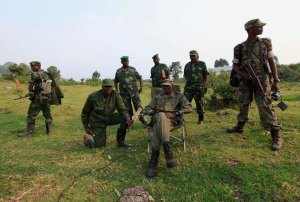
The United Nations Security Council unanimously adopted a resolution last month that extended the arms embargo on the Democratic Republic of the Congo (DRC), while expressing its intention to consider additional targeted sanctions against the leadership of the M23 rebel fighters.
Rwandan support for rebels in neighboring Democratic Republic of Congo may be more widespread than previously believed, according to a report released in November by the UN Panel of experts. The report, noted that Rwanda continues to violate the arms embargo by providing direct military support to the M23 rebels, distributing arms, ammunition, facilitating recruitment and dispensing intelligence and political advice.
Dr. Théogene Rudasingwa, a former top aide of Rwandan President Paul Kagame, now a fierce critic of the regime, agrees with the report. He says despite public denials, President Paul Kagame is directly involved.
“These accusations are certainly based on fact. The UN Panel of experts did conduct an investigation and compiled a report. But for us who belong to the region, even without the group of experts report, we know very well that Rwanda primarily and to a larger extent Uganda had been middling in the affairs of the Democratic Republic of Congo since 1996. So there is a legacy, a continuing legacy, and there is evidence to point that actually the recent escalation of conflict the Congo is actually the creation by Rwanda and Uganda.
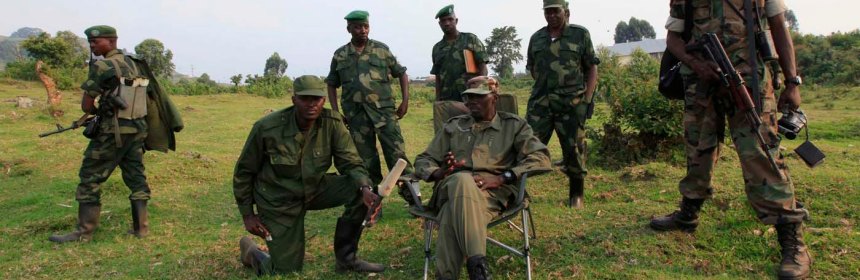
The M23 rebels have withdrawn, at least for now, from the Eastern city of Goma in the Democratic Republic of Congo following an agreement reached with the rebels that preceded meetings with regional leaders in the Ugandan, Capital, Kampala. Congolese activist, Yussa Bunzigiye Prosper, says that at the beginning of their conflict with the government, nobody took M23 rebels seriously, but once they took Goma, things changed, and that President Joseph Kabila should be held accountable.
“The Congolese want to see a government which is responsible, a government which will deal with these issues, and a government which will deliver to them social services, a government which will allow them to be free on their land and enjoy everything on that land.
The International community has been pushing for sanctions that encompass an arms embargo against all armed groups including M23 rebels and a travel ban and asset freeze against individuals or entities that have violated the embargo. But Prosper disagrees with this notion.
“Does the international community really have a say in this matter? The International community has been in Congo for more than ten years with MONUSCO. The same very MONUSCO they’re in Walikali ten miles away from Walikali women are being raped, the same MONUSCO they are in Rubilizi in South Kivu and 30 kilometers away women are being raped, venerable people are being displaces all over their land by militias and they are there… Guess what, they are getting a billion and half dollars every year to do what –to just enjoy the Congo soil… Come on? The international community has no moral authority to discuss this matter.
Critics of Rwanda and Uganda say both Governments have also cooperated to support the creation and expansion of the political branch of M23 and have constantaly advocated on behalf of the rebels some of whom reside in or regularly travel to Rwanda and Uganda. But, both governments vehemently deny backing the M23 rebellion. However, Dr. Rudasingwa warns that observers monitoring the Congo crisis should look at it from the context of these two leaders wanting to be relevant to the international community.
“I think it points to the Character and the state of governance in Uganda and Rwanda because most of these problems that we can see in Congo are more or less an extension of the problems that have not been solved in Rwanda and to a large extent to Uganda itself.”
The international community is optimistic that the rebel’s pullout from Goma might signal progress in efforts to negotiate a peace deal, but only time will tell. Meanwhile, the rebels have given no indication they are ending their eight-month insurgency.
Mogadishu international seaport is bustling with activity as Somalia begins to see a semblance of peace and security from decades of civil war that brought this once booming port to its knees. Today, business has picked up with trucks arriving to offload tons of cargo from ships that are lining its harbor.
Ships from Dubai and Pakistan are arriving with merchandise to be sold in Somalia. As peace grows and normalcy returns following the expulsion of the Islamic militant group Al Shabaab, shipping traffic on the sea has increased– and employment opportunities are on the rise for Somalis who work the port as casual laborers.
“There is a big difference between this year and last year, all our trucks were in the garages and there were hardly any ships at sea. We used to come to the port to look for work but there was nothing. Now there are many ships here, the port is full and others having been waiting for days at sea waiting to dock.”
Years of war have taken its toll on the port, facilities are inadequate and ships have to spend days offloading their cargo, while others wait at sea for their turn. The port has seen an increase in the number of cargo ships it handles– up to 35 vessels per month now dock at the facility, providing the government with much needed revenue, that it can use to rebuild the nation’s basic infrastructure.
“We are continuous run on this ship, first from Dubai to Mogadishu and this time I am coming from Pakistan bringing sugar to Mogadishu. Before this ship was doing about… in the last 14-16 months continues regular run bring different cargo here, general cargo, vehicles, everything to this port.”
Hope is rising in Somalia, after African union peacekeepers, with support from the united nations, seized control of Mogadishu and other parts of the country that were formerly Al Shabaab strongholds. Now, thousands of Somali’s are returning home and business in the capital is on the rise.
Earlier this month, the United Nations Security Council unanimously extended the mandate of the African union mission in Somalia (Amisom) for a limited period of four months.
“The Security Council has just adopted the resolution 2073 on Somalia, but unfortunately what has happened is just a four month extension. We would have expected that it would have been a full year resolution, but because of disagreements on a number of key issues, I’ll explain to you two or three of these issues. One of the issues in particular relates to the maritime component. The African union had made the specific request that the AU and special support package be extended to cover the maritime component.”
The four-month extension fell short of the expectations of Somali ambassador Elmi Ahmed Duale, who told the Security Council that his government had hoped the extension, would be for much longer.
“I hope the security council will not limit itself to the three months approval of the extension, but we were hoping that it would be for one year minimum with all the support required for Amisom and also the Somali national security forces so that they can, in due course, take over the responsibilities of security stabilization and stability within the country.”
Until last year, most of Mogadishu, was, for several years, driven by a fluid frontline dividing the two sides– Al Shabaab fighters– and Somali government troops, with the latter supported by Amisom.
Since Al-Shabaab’s withdrawal from the capital in august 2011, the frontlines have been pushed back to neighboring areas. In late September, Al-Shabaab insurgents withdrew from the port city of kismayo– their last remaining stronghold, but the militant group still controls parts of the country’s south-central areas.
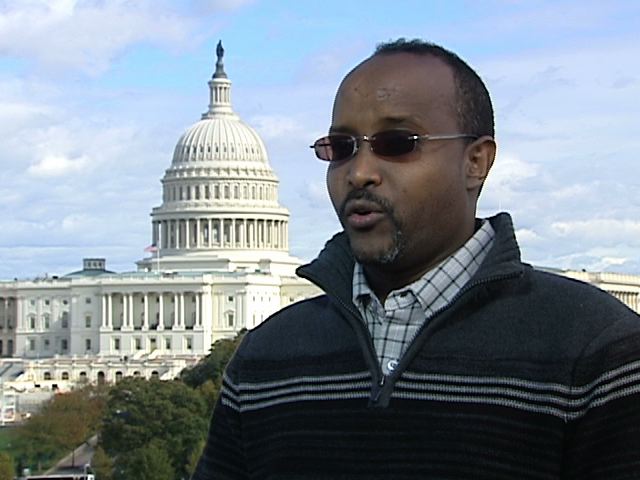
Americans have re-elected their president. And republican challenger, accepted defeat, and vowed to stand behind the people’s choice and work for a better America. It’s the way elections are conducted in this country and works.
The official inauguration day in the United States is January 20th; however, as that is a Sunday in 2013, the public swearing in of President Barack Obama will be Monday, January 21, 2013. Which is also the legal public holiday for the birthday of the reverend dr. Martin Luther king, Jr. Mr. Obama, the nation’s first african American president, was elected to a second presidential term after defeating his republican challenger, governor mitt Romney. President Obama intends to sit down with Mr. Romney in the weeks ahead to talk about how the two can work together in the interest of the nation.
“And you have made me a better president. And with your stories and your struggles, i return to the white house more determined and more inspired than ever about the work there is to do and the future that lies ahead.”
Republican presidential candidate Romney conceded the presidential election in a brief address to a subdued crowd in Boston. He said that he had called Obama to congratulate him on his victory, and he wished the president well.
“I so wish that i had been able to fulfill your hopes to lead the country in a different direction, but the nation chose another leader, and so [wife] Ann and i join with you to earnestly pray for him and for this great nation. Thank you and god bless America. You guys are the best.”
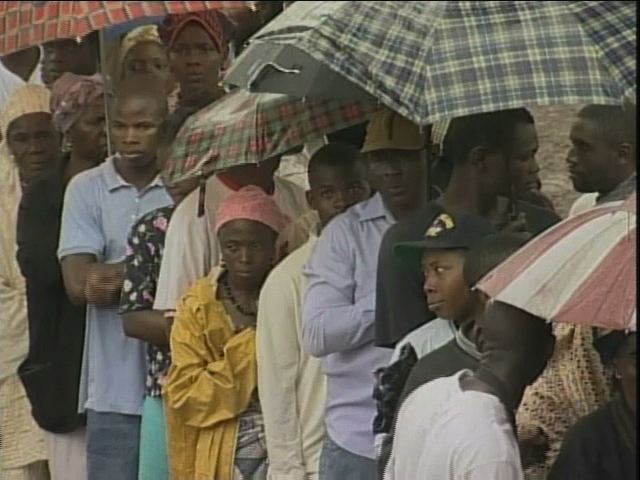
Across the Atlantic – in the West African nation of Sierra Leone, voters go to the polls this Saturday November 17th.
Incumbent president Ernest Bai Koroma the candidate for the ruling — All Peoples Congress Party or (APC) — assumed office in September 2007. Observers say he’s likely to defeat his main opposition challenger, former military head of state, brigadier general Julius Maada Bio – the flag bearer of the Sierra Leone People’s Party or (SLPP). It’s also worth noting that there’re several other presidential candidates seeking the top job.
Analysts say the polls are widely seen as a test of the potentially resource-rich nation. But Sierra Leone remains one of the world’s poorest and least developed countries — this, following a devastating 1991-2002 civil war.
The current government has received praise in the international community for attracting foreign investment, particularly in the mining sector, as well as for improving the country’s aging infrastructure, and the introduction of free health care to certain vulnerable groups.
But the president also faces criticism for failing to tackle extreme levels of poverty – 66 percent, according to the most recent World Bank statistics, and high unemployment rates across much of the country. His term in office has been marred by accusations of corruption leveled against members of his government, including, his running mate, Vice-president Sam Sumana.
Many local civil society monitoring groups and both regional and international organizations are expected to observe the poll.
Mohamed Olad Hassan is an award-winning Somali journalist. Born in the capital, Mogadishu, he is one of the many Somali journalists who have been shot at several times by insurgent gunmen in pursuit of the truth. Despite repeated hardships, his ability to report impartially and objectively, is remarkable.
Journalists working in war-torn countries require steely nerves and an immense amount of dedication. Reporting from Somalia is one of the biggest challenges– and perhaps one of the most dangerous places to be a reporter. This year alone, the committee to protect journalists (CPJ) Estimates that at least 18 members of the media have been killed in Somalia by Al-Shabaab militants. Until recently, VOA’s Mohamed Olad Hassan was an AP/BBC correspondent based in Mogadishu and he says it’s extremely difficult to report from the Somalia.
“It’s a very tough job – – you are constantly thinking about your life, you’re thinking about your safety, and everywhere you go, you’re planning as a soldier without a gun. So that show how risky it is. – You’re always looking around; calling people before you go for a press conference. For instance you ask people for the situation on the ground-you’re working like a security agent – rather than going to cover a story as a journalist.”
There is no strong legal framework to protect journalists in Somalia. They express their sympathy and loyalty with red bandannas tied around their heads every time one of their own is killed. Journalists can be caught in the crossfire of a firefight and have to run for their lives. Video journalists are often the most endangered. Stray bullets and shrapnel from explosions can cause serious injuries.
“I was doing a live report during the Ethiopian – Al -Shabaab fighting in Mogadishu and was filling a story on the fall of one of the helicopters b that belonged to the Ethiopian military — which was shot down by the Islamic insurgents. A motor round exploded in front of my camera and it really knocked me down. I was seriously injured and taken to the hospital and after a few day i was evacuated from Mogadishu to Nairobi for treatment and that was one of my worst assignments, because i didn’t know where i was and I only regained my conscious back when I was at the hospital when i was with my friends and relatives with me.
Hassan says that Somali local radio and TV journalists are often targeted because they’re perceived to be agents of the west.
“The only reason why journalists are targeted is because they are telling what the enemy or what the Waring’s factions do not want to be heard by the outside world.”
In 2010, Harvard University’s Nieman foundation for journalism honored Mohamed Hassan with its Louis M. Lyons award for conscience and integrity in journalism. Also in 2010, he was the recipient of the prestigious “speaker abbot award” given by British speaker of the house of commons to journalists who excel in the most difficult of circumstances while fulfilling their professional duty to report, to inform, and to alert the world to news that it needs to know. Despite repeated hardships, Mohamed Olad Hassan continues to inspire his community and to be the voice of the voiceless.
“Journalism is our profession. We like it, and that’s what inspires us to keep working instead of running away from our enemy. The other thing is that these guys who are killing journalists, these guys who threatening us, these guys who are making explosions, these extremists, want journalists be to salient — so that the voice of the voiceless cannot be heard. So instead of helping them to reach their goals, we’ve decided to keep working and we think that at the end of the day they will be the losers and the Somali journalists will be the winners through the blood of their fellows.”
The United Nations high commissioner for human rights recently released a report deploring the continued attacks on journalists in Somalia. Speaking to journalists in Geneva, Rupert Colville, spokesperson for the high commissioner for human rights, said that they’re extremely alarmed by the continuing assault on Somalia’s media workers and journalists by Al-Shabaab and other elements.”
“The role of the media is crucial as Somalia tries to get back on its feet, and the continued regular slaughter of the country’s journalists risks stifling the media’s ability to contribute to an improvement in law and order and good governance.”
According to the u-n, the 18 journalists killed is Somalia this year, is the second highest total in the world after Syria. This includes nine killed in the past six weeks.
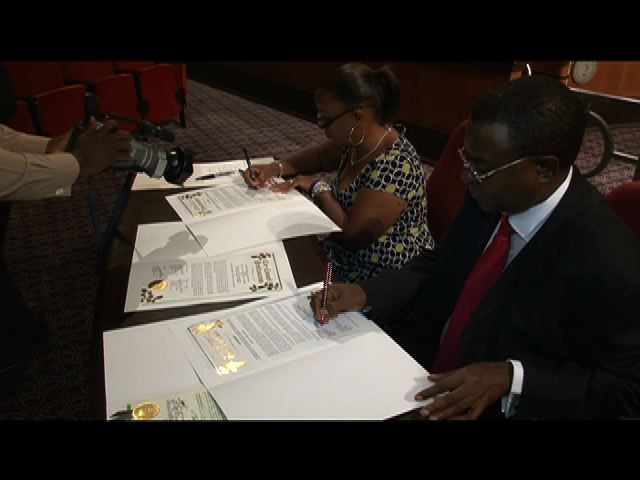
The City of Oakland, CA and Bauchi City, Bauchi State, Nigeria, recently signed the Oakland-Bauchi Memorandum of Understanding establishing the commencement of a sister city relationship between the two cities.
Earlier this month, the City Council of Oakland, CA adopted a resolution establishing an official sister-city relationship between the City of Oakland and Bauchi City in Bauchi State – Nigeria. The partnership was formed to carry out bilateral exchanges and cooperation in wide range of pursuits and mutual interests. Oakland City Councilwoman Desley Brooks spearheaded the initiative, and she says there are a number of opportunities that can develop as a result of this sister city relationship.
“We can take trade delegations there so that there is commerce that can be done, we can do cultural exchanges, we can do educational exchanges, student exchanges, artist exchanges and there’re a number of ways that we can foster the relationship. It depends on what the group wants to do and we can move in that direction. We’ve done things like that with another sister city in Ghana second city of Takoradi, we’ve sent containers of supplies over there, we’ve also had relationships with Accra, and I believe at one point we sent a fire truck out there.”
Engineer Marcel Uzegbu, a former Oakland City employee helped to negotiate the deal. He says Oakland city has a significant Nigerian population and that it was important to acknowledge them. He hopes that the partnership will help to bridge the divide between the two cities.
“The city of Oakland has been there for many years. And if you look at the public works for instance, they’ve developed so many standards, they have different ways of doing work in the city that benefits all the citizens. So those are some of the things that I was doing for the city of Oakland. So I thought by having a sister city relationship, some people from Oakland can come to Bauchi and show them how some of these things are done.”
Mallam Isa Yuguda, Governor of Bauchi State, Nigeria, noted that the West African Nation a history of good diplomatic relations with the United States and that the signing of the memorandum of understanding between the two cities was vital. Bauchi City became the tenth Sister City of Oakland, California.
“My prayer is that many more cities in America would partner with other cities in Nigeria so that we can benefit from the experiences of cities in America in development. We are going to benefit greatly from this partnership in the areas of education, healthcare, tourism, commerce, and so on and so forth. This would go a long way in generating good relationship and partnership between the city of Oakland, the people of Oakland and Bauchi State.”
Governor Yuguda says that Bauchi is home of peace, a home of hospitality, a home of tourism, a home of various cultures and a home of disciplined people who are respectful of both Islam and Christianity.
The initiation to establish a sister city relationship with the city of Oakland was led by Engineer Noah N.A. Dallaji, who is the President and founder of African Children’s Talent Discovery Foundation back in September of 2010 .
Sister City relationships with cities around the world have been in existence for several decades. They are established to foster civic, cultural, education, and business exchange between the sister cities and the countries in general.
Kabeh Sumbo is a Liberian-based business woman who has turned her life around despite repeated hardships. Today, she owns the Passama agriculture trading company that produces and exports palm oil individuals and businesses worldwide. Sumbo, along with 149 other Liberian women, recently participated in a training program for women entrepreneurs. The program was funded by Goldman Sachs and implemented by c-h-f international development in Liberia. Paul Ndiho recently talked with Kabeh Sumbo, about her remarkable journey.
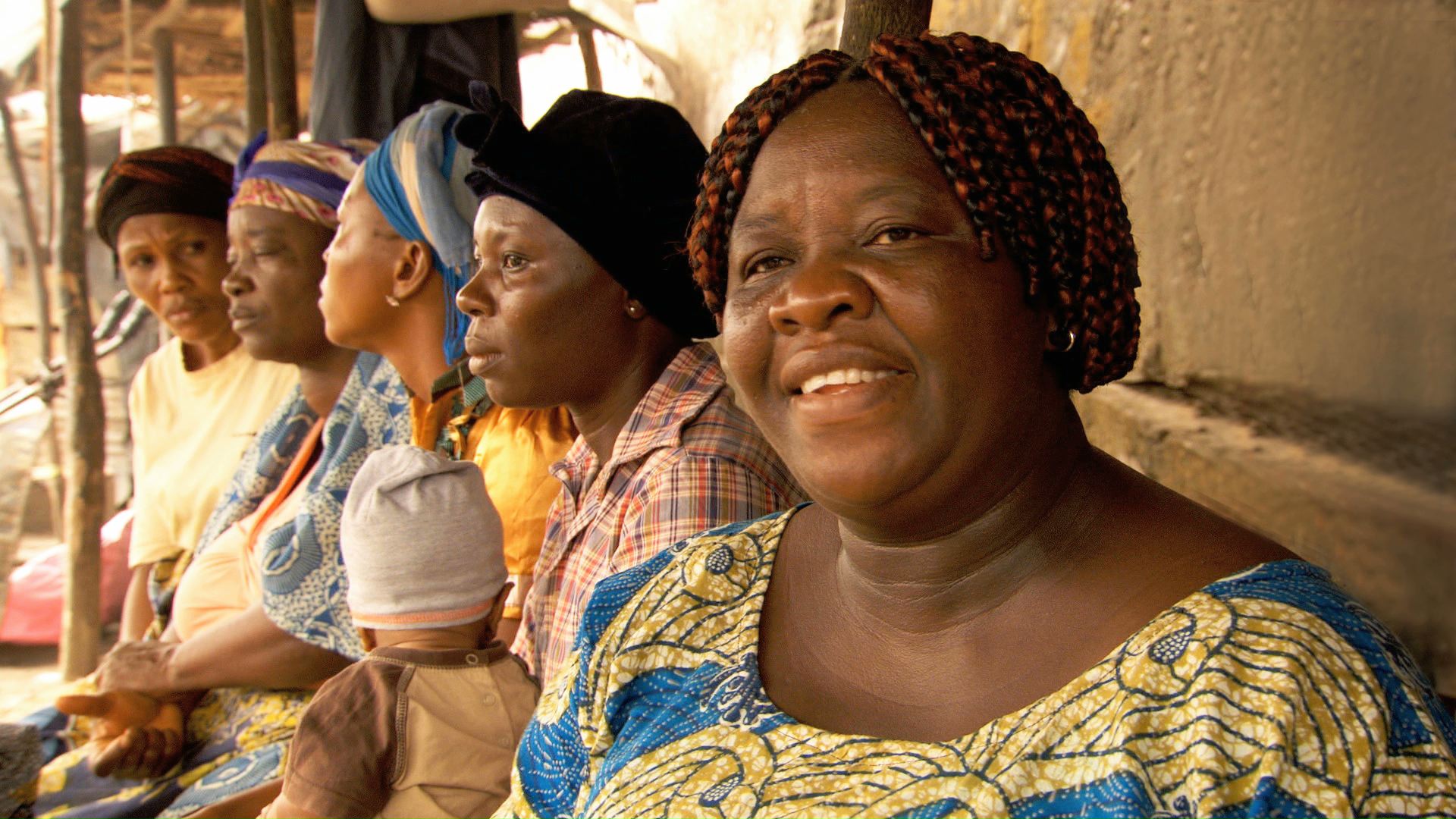
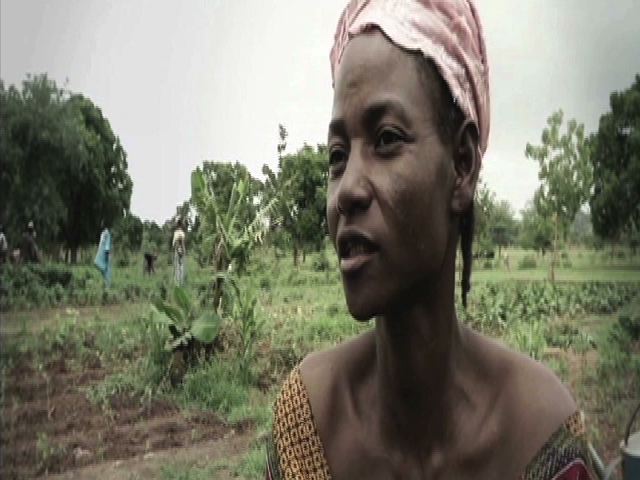
Bordering on the vast Sahara desert, the Sahel stretches across the African continent. Eking out any kind of living here is tough, but a group of women in northwestern Burkina Faso are turning their corner of this harsh, arid region into a lush and productive garden.
In a place where people survive mainly on the staple, but nutritionally poor grain, millet, the vegetables these women produce are changing their families’ diets and lives.
“The nutritional situation of children before the setting up of the project was severe. The children were falling sick regularly. But since we started to work here and the garden started producing vegetables, the children have been less sick and we have changed our diets.”
Poor nutrition is widespread as families rely primarily on grains. Vitamin rich fruit and vegetables are expensive and many mothers are unaware of their importance to the family diet.
“We couldn’t afford vegetables before. Now we can eat them and sell the surplus and generally the situation has improved significantly.”
The women receive training on farming techniques and funding towards the construction of wells. Through crop selection and rotation, the garden is productive year round– and it’s giving the women a more active role in their community.
“The benefits are huge for us and the community in general; it allows us to feed our families better. It also allows us to be a breadwinner for the family; we can help with our children’s school fees, their health and also assist friends and family.”
This project is part of a 1.7 million euro joint action between unicef and the European Union. The four-year project is aiming to reach almost 15-hundred villages across the country. It’s not an emergency response, but an effort to improve nutrition security across the country, so that when nutrition crises occur, families, especially children are better equipped to handle the impact.
Some of the excess fruit and vegetables end up here, at the food market in Ouahigouye where vendors have been taught the nutritional value of their produce and share it with their customers.
“My name’s Sawadogo Detu and this is my stall. I sell yams, potatoes, vegetables and mangoes. I received training about the causes of under nutrition and how to prevent it, so when customers come to buy from me i explain the benefits of each item to their diet and how they should prepare them.”
Nollywood films are growing in popularity in Africa, because they often touch on issues that many people across the continent can identify with. It is estimated that over one-thousand movies are produced in Nollywood each year – most are in local languages – Yoruba, Hausa and Igbo, while English accounts for more than 40 percent of the films produced. Recently here in Washington DC. Paul Ndiho, caught up with Vitalis Ndubuisi one of Nollywood’s actors. Ndubuisi says Nigeria’s nearly one-billion dollar film industry Africa’s biggest after India’s Bollywood and America’s Hollywood has rewarded him handsomely.





 Ndiho Media,LLC.