Ugandan president Yoweri Museveni says external players should refrain from interfering in the countries affairs, days after Ugandan pop musician-turned-lawmaker Bobi Wine called for international action against Uganda following his alleged torture by security forces.
Uganda’s President Yoweri Museveni on Sunday responded to Bobi Wine’s allegations of torture and warned against foreign interference in the country’s politics.
“It is important that external players refrain from interfering in the internal affairs of other countries. Interfering in internal affairs of other countries is morally and practically wrong.” He added that
“There has been so much talk about the torture by the security forces of people like Honorable Bobi Wine and Zaake. This talk is in the media, in other non-court forum, yet, these are matters in the courts of law. What if those allegations turn out to be false, how will the accusers, local and foreign rectify the injustice they have done to the security forces?”
Last week the U.S. lawyer for opposition lawmaker Robert Kyagulanyi, a musician well known by his stage name Bobi Wine, called on the United States to stop funding Uganda’s military as a punitive measure against what Kyagulanyi said was torture by authorities in his country.
“The least I can do is to speak out for those hundreds if not thousands of people that have been brutalized. I got injections that I don’t know about, and I spent quite a long time on cuffs, shackled both hands and legs.”
Bobi Wine, is in the United States undergoing treatment for injuries he says he suffered at the hands of Ugandan security forces while in detention following his arrest on August 14. However, Ugandan officials have steadfastly denied that Wine was tortured while in custody. Authorities have charged Wine with treason for allegedly stoning President Yoweri Museveni’s motorcade. In Uganda, a treason charge can carry the death penalty.
Wine was elected to parliament in 2017 and has gained widespread popularity among the nation’s youth, for his attacks on Museveni and his administration. Many of his youthful followers say they feel excluded and alienated by the nation’s current political establishment.
Robert Amsterdam, Bobi Wine’s lawyer, told those in attendance at the National Press Club news conference that he was putting the Ugandan government on notice.
“We want the American taxpayer to know that the American taxpayer is funding this. The military equipment we are supplying to Uganda is being used in a war of terror against Uganda’s citizens,”
“We call on the U.S. government to immediately suspend military funding to Uganda,”
However, in a statement released to the media, Ofwono Opondo, a Uganda Government spokesperson and Uganda Media Center executive director, rejected Amsterdam’s claims against the Ugandan government — saying quote —
“If Bobi Wine was tortured or injected with unknown substances, as is being claimed, he should quickly return to Uganda to raise those issues before the court, where the trial will be, and they shall transparently be investigated and culprits punished.”
“We strongly reject Mr. Amsterdam’s reference of the Uganda government as a criminal enterprise’ because Uganda is governed following our democratic Constitution, laws, and rules, as well as respect to recognized international standards,”
Despite his alleged mistreatment, Wine says he is returning to his beloved East African nation.
“I must go back home. Uganda is my home,” he said. “I want you (my supporters) to stand with the oppressed, not the oppressor.”
President Museveni, who has ruled Uganda since 1986 and has won a series of elections, receives diplomatic support from Washington for his deployment of troops in international peacekeeping missions — including the fight against militants in Somalia. So far, the U.S. has not commented on Wine’s comments or the President Museveni.
In December, the constitution was amended to remove the presidential age limit of 75 years, meaning Museveni can run again for president in 2021.
Many people say children learn best through trial and error. Here in the Kenyan Capital, Nairobi, – Discovery Center, a social enterprise, has come up with different ways to make science, math, innovation, and technology exciting and interactive. VOA’s Paul Ndiho has more.
It has been said that being passionate about your work is the key to success. Daniel Gichuki Muhoro is no exception.
“For me, science is a big thing. It’s all was about passion, it was about fixing and solving problems from the time I was ten, or eleven. And even when there’re problems at home, my mom would say that Daniel will come to fix this.”
Muhoro’s passion triggered him to start Discovery Center where children are inspired to develop an interest in science. Science presentations, experiments, competitions, exhibitions, field trips, and computer programming.
“We make science and technology fun for children of all ages. Our mission is to star innovation, and we believe children’s innovation and inquisitive nature needs to be natural.”
Muhoro has turned his love for engineering into a business, this warehouse is now a creative hub for innovation.
“At the back of our lives, we’d like to impart life skills to children in logical thinking, problem-solving, and critical thinking skills. But at the same time, we want to influence more children to take science careers.”
As Kenya becomes more connected to the internet, young people are finding new ways to hone their skills — and learning how to code to become computer programmers. Discovery Center is now part of a new infrastructure for children to develop their technology skills.
” We have a coding club where we introduce computers for kids of all ages. For example, we have seen some university student who has come to us and said I want to learn another skill like in Coding.”
Muhoro says through their coding club children also learn to develop life skills.
“In this country, if we don’t influence the children towards science, technology, and innovation they’ll get there but will be left out. All we want is to have an impact on the young generation where they can take careers in Science and technology and if they don’t still have important skills.”
Like any start-up company, Discovery Center is not without its challenges. Critics say that getting these programs rolled out in rural areas has been a slow process. But, Daniel Muhoro is hopeful that working with schools and organizing science fairs and projects will eventually pay off. He says the program has the potential to be replicated across the country.
Constitutional reforms in many African countries aim to provide more social and political inclusion. In some cases, that means giving greater powers to lower levels of government. Political inclusion can also mean setting quotas for women and other minorities or giving a greater say to local communities.
African democrats say the combination of structural reforms and progressive legislation should ensure the voices of the poor and disenfranchised are brought into government decision-making. Increasing the numbers of women political representatives has also become a significant constitutional issue in most African countries.
Most but not all African countries encourage the inclusion of women and minorities in another essential way to help in bringing services closer to the people.
In Rwanda for example, the constitution provides a quota for women and other groups in government. As a result, Rwanda has one of the highest numbers of women in parliament in Africa, nearly 50 % in the lower chamber.
In Kenya, the 2010 constitution introduced a constitutional requirement to guarantee women’s membership in parliament, the judiciary, and other state organs. It also created a decentralized system of government called devolution. About 20% of the national budget goes to 47 counties, also handing them responsibility for primary health care, early education, local roads, and other infrastructure.
However, critics say devolution is failing. Corruption is so widespread, and this has affected service delivery. Kenya has also been rocked by a series of strikes from the medical practitioners, doctors and nurses – lecturers at public universities – teachers refusing to teach over poor pay.
Earlier this year, President Uhuru Kenyatta’s government pushed ahead with a plan to hire 100 Cuban doctors despite opposition from a doctors’ union that says the money could be used to employ local physicians instead.
Some constitutions support local government efforts to give citizens a direct say in prioritizing the services they need from limited funds. For example decentralization in Uganda. In 1997, the country adopted Local Government Act, which decentralized system of governance – Critics say the system is primarily built on patronage. Uganda’s longtime leader Yoweri Kaguta Museveni uses this form of government to reward districts or regions that are favorable to the ruling party.
Another Issue is corruption which at all time high – thus hindering the country’s economic development, Uganda has one of the worst healthcare systems – Public hospitals are a death trap, most districts cannot collect enough taxes to pay their civil servants. The country has also been hit by a series of strikes from the medical practitioners, doctors and nurses – lecturers at public universities – teachers refusing to teach over lousy pay. Recently, the gov’t hired Cuban doctors to work in public hospitals.
Nigeria adopted a federal system that allows citizens to elect their representatives at the state and local levels. The states also have their courts and can collect taxes for their use.
Analysts say Nigeria’s, system is supposed to bring service delivery closer to the people. However, critic says this has not worked. The lack of transparency and accountability from both central and states governments has to lead to widespread corruption affecting service delivery.
2017 Transparency international Global Corruption report ranked Nigeria 148 / 180 as one of the most corrupt countries. President Buhari has taken a different approach to fight corruption, but it remains rampant under his leadership.
These systems of government if executed well, can bring about the desired development and help local governments to charter their destiny. But for now, that remains to be seen.
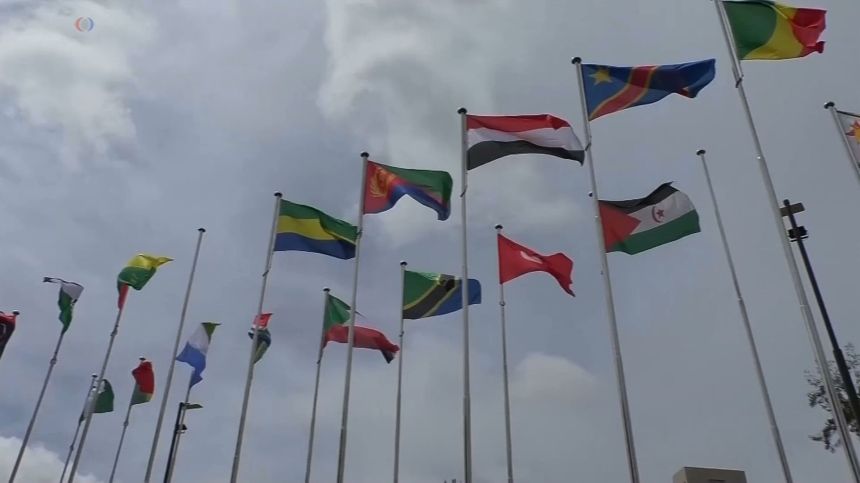
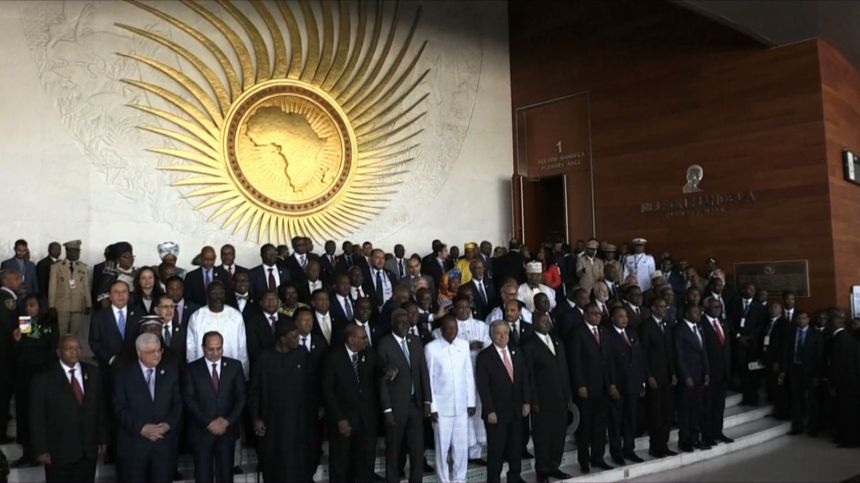
African heads of state wrapped up the 31ST African Union Summit in Nouakchott, Mauritania earlier this month. Essential items on the agenda included structural reform of the organization, the African Continental Free Trade Area, and ways to resolve crises in Africa and the realization of the African Agenda 2063.
Following the conclusion of the Summit held in Mauritania 49 of the 55 member states of the African Union (AU) have now signed the agreement establishing the African continental free trade area (AfCFTA). While six countries six ratified the deal.
A $3 trillion continental free-trade zone encompassing 1.2 billion people would be the biggest in the world by member states, in a bid to increase intra-regional trade, which sits at a measly 15 percent of Africa’s total commerce.
Corruption was high on the agenda. In line with the 2018 theme “Winning the fight against corruption: A Sustainable Path for Africa’s Transformation,” Nigerian President Muhammadu Buhari the chairman of the AU anti-corruption who has made clean governance his pet issue, lead the bloc in the fight against corruption, and encouraged member states to combat illicit financial flows, strengthen their national anti-corruption agencies and invest in the demographic dividend amongst other measures.
On peace and security in Africa, the summit reaffirmed its support for the imposition of punitive measures against those obstructing efforts to achieve reconciliation and peace in South Sudan. It also welcomes efforts to normalize relations between Ethiopia & Eritrea.
During the summit, AU Chairman, Rwandan President Kagame indicated France as an essential partner in fighting against the terrorism in Africa, and he emphasized that it was the reason why the AU was pleased to welcome French President Emmanuel Macron at the Summit, which was overshadowed by security failings in the Sahel.
Analysts say that when it comes to the issues of peace and conflict resolution, the AU has done considerably well, in contrast with its predecessor, the OAU. The OAU adhered to a doctrine of “non-interference,” something that portrayed Africa in the negative light.
Another significant highlight was the African leaders created a body to help coordinate national policies on migration and agreed to set up an organization called the African Observatory for Migration and Development based in the Moroccan capital of Rabat.
Critics say that despite these structural reform undertaken by the African Union. A constitutional crisis remains a prevalent issue which many African countries. The AU has also come under criticism for failing to deal with African leaders who do political maneuvering to remove or circumvent term limits. For example, some incumbent presidents have exploited ambiguities in the law to extend their terms. Analysts argue that perhaps just like they have taken a stand on coups the same should apply to leaders who change their constitutions to stay in power longer than their mandate.
Several African nations have taken steps to improve access to sanitary products for both women and girls. In Kenya, Sisters are using technology to make that a reality. They’ve created their own ATM dubbed Dial a Pad, which seeks to make pads accessible to every school-going girl in the country.
Kenyan sisters Faith and Linda Kimeu are making their mark in the innovation and tech space. Their award-winning automated tailored machine ATM – DAIL PAD that dispenses sanitary pad at a low cost is generating a buzz and hopes this innovation could be the game changer.
“Dial Pad utilizes both software and hardware technology to address menstrual health issues and sexual reproductive health.”
Faith says that Dial pad was born of a two-year interaction with poor schools faced with the dire situation and lack of menstrual hygiene education in different parts of the country.
“From our interactions we’ve seen that a lot of girls don’t have a crew from what is normal and not normal in matters partnering to sexual reproductive health and menstrual hygiene, there was completely luck of Knowledge.”
Kenyan government recently announced that it will begin distributing free sanitary pads to every one of the 4.2 million girls in its public schools.
“Our president signed the Bill of free Pad into law, so it’s in effect right now –The reason she is saying that we’re focusing on schools is for accountability purposes.”
Through the initiative, which is part of a program announced last June aimed at boosting girls’ access to education, the government has started handing out 140 million sanitary pads to schools.
Linda Kimeu explains how the AMT works
It prompts you to press the start button— Asks you which kind of Pad do you want, I choose normal and then, It tells you that each pad is ten shillings and how many pads do you want? Because I only put ten shillings, I choose one.” I pay ten shillings and wait for the pad that the dispenser.
A study done by ZanaAfrica, a Kenyan non-profit organization says nearly one million girls miss school because they lack access to menstrual hygiene supplies. Linda Kimeu, a co-founder of dial pad, says this technology is going to help millions of girls stay in schools.
“Normally girls miss schools because of periods, but now when we provide them with this, you will have to class, school because your periods are catered for…”
Faith and Linda have also successfully competed at different levels including the Lion’s Den challenge by KCB where they got Shs 500,000 that they used to create the App where their clients get to choose and buy sanitary napkins, cups or tampons using the mobile money payment system Mpesa
Until recently most of the vegetables consumed in Zanzibar were imported from other parts of Tanzania. But due to the rising demand from the tourism sector, restaurants, hotels and Zanzibar farmers, are gradually taking up horticulture to boost their source of income.
The semi-autonomous island of Zanzibar is home to over a million people, the majority of whom are subsistence farmers. Over the last 20 years, the tourism industry has grown steadily, overtaking what was once the backbone of the nation’s economy, agriculture. Nearly 80 percent of the vegetables used on the island is now imported from other parts of Tanzania. Abdullahi Yahie, an agriculture economist, retired from the African development bank, wants to change this image.
“Our primary goal is to ensure that Zanzibar will get into a position to in fact, rather than import, export vegetables as well as other horticulture to Tanzania as well as to the region.”
Since moving to Zanzibar, Abdullahi has launched an agriculture investment and development company. With the goal of supplying hybrid seeds and raising the awareness of the farmers and to convince them that agriculture is just like any other business, and it can generate enough income for the farmer.
“People realize that it is worth trying. We can see now a lot of people, not ordinary farmers, but even businesspeople are getting into farming, now civil servants are getting into farming. So the feeling is that now the culture is changing.”
It was this passion that triggered him to start Zanzibar agriculture investment and development Inc.
“When I settled here, I recognized that there are a lot of challenges in agriculture and in particular that the island has been very much dependent on imported horticulture, mainly from Tanzania, as well as also Kenya and the neighboring regions.”
Environmentalist says Zanzibar’s climate is favorable for a variety of crops and with improved seeds, productivity stands to increase rapidly.
“Our focus is to ensure that people view agriculture in Zanzibar as a business given the fact that they have a lot of fertile lands as well as plenty of water.”
Abdullahi Yahie’s company is assisting the growers through providing them with inputs, especially quality seeds as well as advanced technology and training to enable the growers to undertake this new type of farming without a problem.
“We advise the farmer on how to use the pesticide, fungicide, maybe direct them on how to control the disease using the pesticide and also how to maintain the farm.”
Critics say poor roads, limited transport facilities and no storage facilities for vegetables, force a lot of farmers to abandon agriculture. But Yahie says these challenges present a great opportunity.
“If the trend continues the way, it is right now, the growing interest we have seen with the local population to get into farming my impression that within five years Zanzibar will be an exporter instead of an importer.”
He hopes that today’s flourishing horticulture industry will help people reduce their annual importation of vegetable from mainland Tanzania, the most prominent supplier of agricultural products to Zanzibar.
A Zambian youth is making strides in innovation and technology. Joseph Lungu is one of Zambia’s youngest innovators, having designed a sports car and security system for motor vehicles.
Joseph Lungu is no ordinary person, at 25 years old, he has earned several ingenuity awards. He has a passion for fast cars, but his ability to build his own car from scrap metal is remarkable. He recently unveiled his latest automobile at a trade show Lusaka.
Lungu has also designed a safety and security device using a cellphone to monitor overloading passenger service vehicles. He discovered his love for innovation when he was just 10 years old.
“I came up with a system that once the vehicle is overloaded, it automatically switches off. At the same time it will make a call to the owner of the vehicle. He will receive a text massage or a video call to alert him or her that car is being overloaded….
Joseph Lungu, comes from a very humble family. He was the winner of the 2017 Zambia innovation award. His innovations are generating a buzz even though they’re still at prototype level.
“I want to prove to Africa that even us, we have the brains that we can use to change the whole world.”
Joseph works at home, where he has turned his family home’s backyard into his workshop — he calls Joe Tech garage.
He uses his engineering skills to design all sorts of electronic products. From a personalized ATM machine, to a custom sports car, to his award-winning car security system.
“I came up with a domestic ATM machine, whereby you’re able to withdraw money using your personal mobile phone. The cool thing about this ATM you’re able to deposit and withdraw money using your mobile phone.”
His goal is to solve problems using scrap metal and information he finds on the internet.
“In Africa we have a lot of problems. I can come up with solutions in agriculture, in the transport business, energy … all it takes is to see where people have problems and you see a solution.”
Parked outside his family’s compound in the Lusaka suburbs is Joseph’s father’s car that he uses for demonstrations.
They configure your number in the vehicle’s system.
This is a point when you put more weight on the car, the car engine will stop and sound and arlm. You see it can’t start…. I have also received a call to show that my vehicle is being overloaded.
The vehicle sensors automatically stop car from moving. Joseph hopes to inspire other young people.
“If you have a dream, if you’re focused, and you have a plan, you can make it without money. Convert that Idea into reality. It only take you believing in yourself that you can do it then you’ll do it.”
Finding funding for his projects is difficult. Joseph says that he depends entirely on his family’s income. But despite the challenges, he remains optimistic.
“I made a touch four sensor which is able to detect the force of a human being. If someone parks the car and activates the system – The moment you want to steal, let’s say the tire, the moment your apply the force on the tire then this system is able to trigger the sensors and it will alert the owner on a mobile phone.”
With his innovation, experts say this could be a game changer, and for a kid whose dream is to dream big, he believes with the right support it can become a reality.
The country’s biggest public works project since colonial times is a $5 billion test of the Belt and Road Initiative’s pledge to be a ‘win-win’ for China and African partners.
It is the biggest public works project ever in Kenya. A $3.8 billion bet on the country’s economic future.
Sealed on a deal with China – to help build a sprawling rail network in east Africa …
They call it the ‘Madaraka Express’ – after Kenyan independence day.
And in its first year of operation, it has given Kenyans new freedom and optimism.
A 10-hour drive time between the coastal city of Mombasa and the capital, Nairobi …… slashed by half or more. Frederick, passenger from Nairobi:
“Really there is no comparison to the transport system that we’re used to.”
Shipping costs slashed by half, too – a shot in the arm for business and – hopefully – new jobs.
The train – more widely called the ‘S-G-R’, for standard-gauge railway – is a critical link in something far bigger:
China’s massive ‘Belt and Road Initiative’ – a trillion-dollar plan to finance and build railroads, ports, roads and other huge projects in nearly 70 countries.
China casts Belt and Road as a friendly effort to help emerging economies like Kenya’s.
But the deals are boon for China, too. Chinese state banks lend the money. Then, Chinese companies cash in on construction deals.
Yunnan Chen, is a research fellow at the China-Africa Research Initiative, Johns Hopkins University
“So these infrastructure projects are not altruistic projects. … What Chinese companies get out of it are lucrative infrastructure contracts, where not only Chinese construction firms win these contracts but they also pull along smaller suppliers and other Chinese companies that also get to participate.’’
Belt and Road projects are certifying China’s ascent to the top trade partner for African states.
“If anything it’s an acceleration of existing trends we’ve already seen for the past decade or more, where China has already overtaken the U.S. in terms of being the primary economic partner for African countries and for the continent as a whole.
“Africa does not take the same priority in U.S. foreign policy as perhaps it used to, and it doesn’t occupy the same sort of attention. Whereas for China, the relationship has become, over a decade or more, very politically institutionalized.” she said.
And African countries are getting a payoff.
An extensive survey by McKinsey consulting found that thousands of Chinese-owned firms – some big, some small – are hiring, training and promoting tens of thousands of African workers. Jackline Kemboi, Train Attendant, SGR
“It’s a win-win for me. If you don’t have the Standard Gauge Railway, you’re going to be losing on the economy. … We’ll go back to the ‘80s and ‘90s. We’ll never grow as an economy.”
Kemboi’s story is one the Kenya government wants to reproduce.
She landed a good-paying job after graduating from the railway’s training school.
Ms. Milly Kiziili-Otieno, Kenya Railway Training Institute Principal
“With the SGR training I think we have trained close to 1,000 graduates who are currently running railroad.
“Our graduates have been handling the cabin crew, the maintenance, the passenger operations – all the people that would help in the running of the train have actually passed through this institution.”
Kenya hired Chinese state-owned companies to build the railroad, then operate and maintain it for up to 10 years, when enough Kenyans will be trained to take over.
“The training period is about 3 to 5 years in China. It takes about 3 years to become an assistant driver and 5 years to become a driver.
“For less than one year of training, the Kenyan trainees are still interns.”
Another success story: Edgar Sirucha, a Mandarin-speaking civil engineer.
He was hired by China Railway Construction Corporation to work on roads.
“I studied in China for my bachelor and master’s degree, and it was in engineering. And to see a country that has been so developed, I carried the dream here. And I hope one day I see a Kenya that is so developed or even further developed than China.”
But the SGR has also become hugely controversial.
Most recently, the arrests of Kenya Railway’s managing director and the country’s land commission chief — accused with others of fraudulent SGR property deals.
And there are complaints that the Chinese kept the best-paying jobs for themselves … mistreated Kenyans in lower-skilled positions … even segregated them in cafeterias.
Kenya Railways and lawmakers are investigating the treatment of workers. The officials accused of land fraud pleaded not guilty.
For his part, Sirucha said tensions sometimes do surface on the job … but they can be overcome.
“Coming here, of course there are challenges. I’ve got people who complain the pay is low; I’ve got people complain the hours are long. I’ve got people who complain the Chinese don’t treat them right. Everyone has a reason to complain.
“But if you have a vision, if you have a driving force – that makes those problems be actually stepping stones.”
Kenya’s economy has been growing – but not as fast as neighboring Ethiopia – where the Chinese also financed and built a railway.
The government is counting on the SGR to deliver. Already the line is being extended to connect with proposed industrial parks and eventually reach into Uganda.
James Macharia is Minister of Transport, Infrastructure, Housing & Urban Development:
“As you know the plan is to have the SGR contribute about 2.5 percent of GDP. You’ve seen the impact of the transport from Mombasa to Nairobi, both for passenger and for freight.
“And so by the time we put the SGR up to Malaba it will be adding another 2.5 percent of the country’s GDP.”
Other Kenya Railway and government officials declined VOA’s interview requests. So did the SGR’s builder, China Road and Bridge Corporation, and the Chinese embassy.
In Mombasa, officials say cargo traffic is growing thanks to the SGR’s lower costs.
Until recently, Catherine Mturi-Wairi was managing director at the Kenya Ports Authority.
“We are looking at $250 for a 20-foot container and $300 for a 40-foot container. Compared to trucks we are looking at $700 US dollars for a 20-footer, and $800 US. So it is definitely cheaper to go by rail.”
But what’s good for the SGR isn’t good for long-haul truckers.
They say the train already has cut into their business. Mahfudh Mbarak Mahfoud is a long distance track driver.
“The business was great in the beginning. The trucks would leave from Mombasa to Kampala, unload the containers and come back. That’s how we worked.
“But since the SRG, our work has been affected.” “The future doesn’t look bright.”
Officials say that in the end, truckers will benefit as container traffic increases at points inland.
“The railway can only take up to 40 percent of cargo. … So you will find that whatever is taken up by the railway line, ultimately has to be trucked to someplace.” The SGR’s economics depend on more than cargo and passengers.
To build the railway’s first leg, Kenya borrowed almost all the $3.8 billion-dollar cost from the Chinese.
Same for the next section – now under construction – another 1.5 billion dollars. The debt makes China far and away Kenya’s biggest lender.
Repayment was forgiven for five years – but in 2019, loan obligations to the Chinese will rise more than 5-fold.
Critics fear the debt will make the SGR a long-term loser – a victim to China’s “debt-trap diplomacy.”
Akshay Vishwanath is an environmental activist who studied SGR finances.
“Any country any business any company uses debt to grow. But the magnitude of that debt, the ability to repay, the magnitude of those loans in comparison to the gross domestic product all does matter.
“And I don’t think that level of analysis has been conducted for this project, and therefore I say we need to worry.”
SGR passengers already are paying 70 percent more for tickets than when the train launched a year ago.
One of the SGR’s fiercest opponents is Okiya Omtatah Okoiti. He has filed lawsuits alleging Kenya failed to do sufficient economic or environmental studies.
Instead, he said the government bowed to the Chinese.
Okiya Omtatah, lawyer and activist
“With the Chinese, everything is negotiated in China, the money is paid in China like the SGR money. What is brought to Kenya is the debt.”
Omtatah said China should be working to lessen financial risk for African states that take part in the Belt and Road Initiative.
“… So you can end up with a developed China and a developed Africa. But we’re going to end up with the corrupt states in Africa, with a thriving China, which is the main problem we have.”
Across Africa, the needs are great. The Africa Development Bank said countries face an annual infrastructure funding gap of some $70 to $108 billion. China has pledged $60 billion in financing for Belt and Road projects in Africa.
“There is some justified skepticism on the part of the World Bank and other economic financiers on the economic viability of these new railways.”
“Estimates for justification of the Kenya railway really depend on whether the target for freight can be met. This will depend in a large part on how well the Chinese and Kenyans can cooperate to localize skills and knowledge to operate and maintain the railway in order to make it sustainable.”
It’s too early to say whether the Madaraka Express will be an engine of progress for all Kenyans.
But there’s no doubt it’s already a win for the Chinese.
Nearly 4 million people live in Nairobi, the capital of Kenya.
Perhaps no big city has such an abundance of nature — right at its back door.
“This is like what Central Park is to New York.”
Trish Hayes has been a Nairobi National Park fan for many years.
On the border of one of Africa’s fastest-growing cities, it is home to endangered rhinos, lions, buffalo, giraffes – more than 400 species.
The British first protected the land in the 1940s. And it has remained unspoiled …
Until now.
Kenya’s government is extending the country’s new Chinese-built railway straight through the heart of the park …… splitting the cherished preserve in two … … and igniting a firestorm. Opponents say they were blindsided.
Until his death earlier this year, Sidney Kuntai led the coalition fighting the route. He said construction started before most Kenyans understood.
“In the last one year and a half … This matter was kept in the dark.”
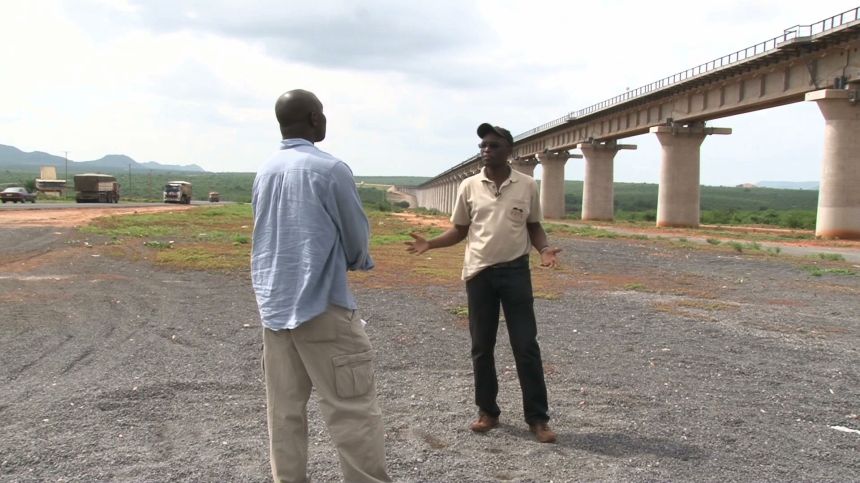
Chinese contractors erected massive concrete pillars – an elevated track visible from one end of the preserve to the other.
The railway, known as the S-G-R, is a vital link in China’s trillion-dollar “Belt and Road” initiative – a massive effort to build railways, roads and ports linking Africa, Asia and Europe.
China promises to lift emerging economies like Kenya’s with new trade and manufacturing.
But there’s also an environmental price to pay.
According to the World Wildlife Federation, that hundreds of threatened and endangered species stand in the way of China’s construction plans …
Critics say that in the rush for jobs, Kenya’s government failed to properly study the environmental impact.
Lawyer Okiya Omtatah Okoiti joined conservationists who sued to halt the extension.
“I got court orders stopping it, until there were some few basic minimums, like an environmental study to understand the impact of the SGR on the environment, a socioeconomic survey, what was the impact of the SGR on the communities where it was going to pass.”
But ultimately, the challengers lost in court.
“All these things are not in place, and the Chinese are busy blasting.”
The Kenya Railways Corporation and Chinese builders declined to answer VOA’s questions or agree to interviews about Nairobi National Park.
But the Kenya Wildlife Agency did allow VOA to visit the Tsavo National Park in central Kenya to see the SGR’s impact there.
The railway’s first leg, from Nairobi to Mombasa, opened a year ago. It cuts through the five-thousand-square mile preserve.
A busy highway and older rail line already split the park.
The new train adds yet another obstacle, disrupting wildlife migration and attracting human squatters.
Dr. Ben Okita is with Save the Elephants. He is helping Kenya Wildlife to study the environmental effects.
“One major impact the SGR has had on the ecosystem is to do with interfering with the contiguous movement and the ecosystem. So, it’s contributing to further the splitting of Tsavo East and Tsavo West national park.”
The Chinese built eight high overpasses to allow wildlife to move freely under the train.
To see if they’re working, Okita uses GPS collars to tag elephants and track their movements.
His maps show signs that the animals are confused.
“There is crossing, but then you can see there are some sections, where the animal seems to be struggling. They stay right there doing a lot of pacing here.”
Making matters worse, humans are drawn to the overpasses because they create park access for livestock and scavenging.
“Because of these human settlements, when animals want to come through, they reach a point where they’re scared. … So then that underpass eventually is rendered useless for wildlife.”
The Chinese built concrete and wire fence guards the track from animals. But they are failing.
“This outer fence line is barely one year old. And you can see already seriously damaged by wildlife. And because of that, the risks of wildlife crossing over and causing accidents are very high.”
Now, all the original fencing is being replaced.
Alex Mwazo of Kenya Wildlife Service is on the research team at Tsavo.
He said most animals – Zebras, Buffaloes, Antelopes, even Lions – are slowly adjusting.
One exception: The giraffes.
“Giraffes tend to be shy animals, so it will take time before they actualize and gain the confidence and start utilizing the underpasses.”
Lala Frederick is the leader of Mwazo’s research team.
Although buffalo and other animals have been hit by the train, Mwazo said SGR is less of a risk than trucks on the nearby highway.
“Their main problem is not even the railway, I think the road adjacent to the railway, is just a like a brick wall.”
While scientists studied the impact on Tsavo, Kenyans looked on with alarm as the train cut Nairobi National Park in two.
Their protests in March came too late.
By that time, Chinese builders had bulldozed into the preserve, quickly erecting an imposing row of concrete pillars to support the track.
Eventually the route will extend to the Ugandan border.
Long-time neighbors say the government turned its back on the park’s heritage.
Kitengela Glass sits at the end of a long dirt road in Oosilikron, south of the park.
Owner Nani Croze has collected newspaper clippings documenting every twist of the railroad construction.
“They had so many different maps, and I’m sure it was to confuse people, because nobody knew when we …
Croze said something precious is being forever lost.
“We have so few animals. African animals. Where do you find them? In Kenya! Maybe a few in Tanzania. Maybe a few, not even Uganda any more.
And how can you — this is such a treasure! This is a treasure of the world.
And here you come, and you sell it to the Chinese? For a railway? Bloody Hell!”
On a South African airliner, much like this one, Shaka and I left from Dulles international airport outside Washington DC on the evening July 17th. It was a tremendously exciting, rewarding, productive and tiring trip.
We started out in Zimbabwe, where Shaka moderated the hugely successful and widely attended first ever presidential debate — in a post-Robert Mugabe era. The television, radio and internet broadcast was co-produced by the voice of America and the rising zimpapers television network.
We covered political rallies for both the leading opposition party – mdc alliance and the ruling party zanu pf. The general elections to elect the president and members of both houses of parliament were held on July 30th. On Election Day, Shaka visited different polling stations to witness the voting process which was mostly peaceful. Journalists and observers were granted access to all polling stations.
However, deadly protests broke out after supporters of the opposition felt that preliminary election results announced by the Zimbabwe electoral commission did not reflect their own exit poll tallying. But the final official election results showed that incumbent Emerson Mnangagwa won last month’s presidential election with 50.8% of the vote, while Nelson Chamisa of the m-d-c alliance trailed with 44.3%. The opposition alleges that the figures were manipulated.
I met with “citizen’s manifesto”, a non-partisan coalition of young Zimbabweans representing various constituencies; civil society, faith-based organizations, students, youth and women who want to see a better Zimbabwe.
My next stop was “impact hub Harare”, a co-working space where change makers, social disrupters, impact innovators, and entrepreneurs interested in solving everyday problems gather to see their start-ups launched.
From Zimbabwe, Shaka traveled to Malawi and his first stop was a meeting Malawian journalists — and a meeting with the former official hostess of the late Malawian president Kamuzu Banda.
Shaka also had a one-on-one with former president, Bakili Muluzi, in Blantyre. Muluzi served as the first freely elected president of Malawi from 1994 to 2004. As Shaka would say — Muluzi is retired but not tired, he is involved with many charitable organizations.
Shaka also conducted an exclusive interview with Malawi’s vice president Saulos Chilima, who has expressed interest in running for president in next year’s elections. Chilima, 45, a former chief executive officer of the mobile-network operator “Airtel Malawi limited” left the ruling democratic progressive party last month, saying corruption in the government is at an all-time high. We’ll have more of Shaka’s interview with Chilima on an upcoming episode of straight talk Africa.








 Ndiho Media,LLC.